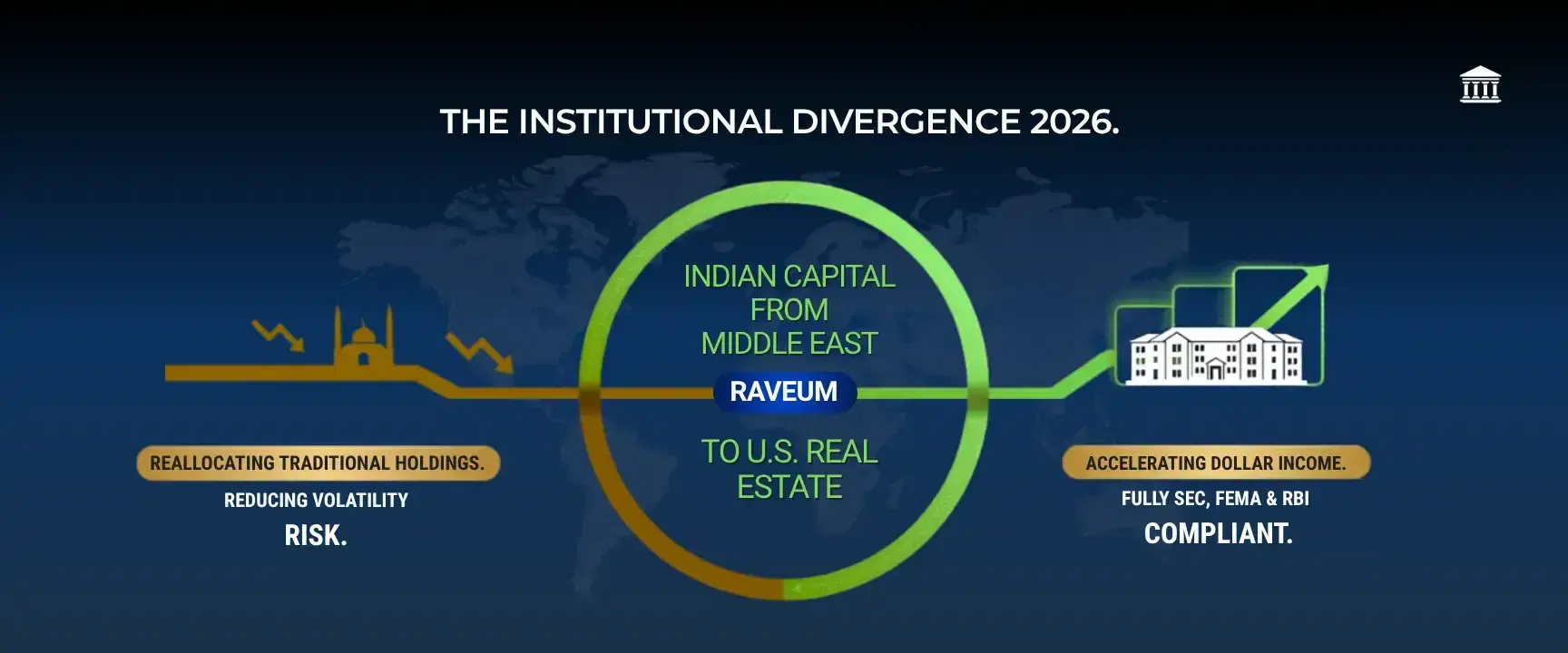
Why Indian Wealth Must Look Beyond Dubai to U.S. Real Estate Amidst Middle East Escalation
The geopolitical architecture of the Middle East is currently undergoing a severe and volatile stress test. With the escalating Iran-Israel conflict, the illusion of absolute regional immunity for investors has been irrevocably shattered.
Recent reports of military strikes, drones, and explosions echoing across the region including incidents in Bahrain, Doha, and Dubai have put global markets on high alert.
For Indian private wealth and ultra-high-net-worth individuals (UHNWIs), reports of a Dubai building being struck by attack debris serve as a stark, unavoidable wake-up call for international diversification for Indian investors. As missile strikes and retaliatory campaigns threaten to turn Middle Eastern financial hubs into volatile conflict zones, it is time for sophisticated Indian capital to radically reassess its definition of a "safe haven."
Historically, the Indian diaspora has flocked to the Emirates, attracted by geographic proximity, lifestyle benefits, and highly lucrative tax structures. However, as the drumbeats of war grow louder across the Gulf, the aggressive pursuit of tax-free yield comes with profound concentration risk.
In times of profound geopolitical crisis, global capital inherently flees to structural security.
The United States remains the ultimate global financial anchor, offering unparalleled macroeconomic stability, fiercely protected private property rights, and a mature regulatory shield against the volatility currently gripping the Middle East.
For generational wealth preservation and how to protect wealth from rupee fall, the strategic mandate has never been clearer: Indian capital must pivot to the United States.
The Illusion of the Gulf Safe Haven and the Yield Trap
To understand the necessity of this geographic pivot and international diversification for Indian investors, one must first examine the massive volume of capital currently exposed to Middle Eastern volatility. In 2025, Indians emerged as the largest demographic of foreign buyers in Dubai, injecting an estimated ₹85,000 crore to ₹95,000 crore into the local property market. The mathematical draw is undeniably powerful: Dubai boasts gross residential rental yields ranging from 5% to 11% in a 0% personal income and capital gains tax environment.
However, this aggressive capital allocation ignores a critical macroeconomic vulnerability: sectoral concentration. The Dubai Financial Market (DFM) and its broader economy are overwhelmingly anchored in real estate and trade. In 2025, the Real Estate, Renting, and Business Services sector accounted for 37.6% of new member activity in the Dubai Chamber of Commerce, closely followed by Wholesale and Retail Trade at 34.5%. This immense concentration makes the region acutely vulnerable to global trade disruptions and regional warfare.
Furthermore, macroeconomic causality tests reveal a sobering reality about global financial hierarchies. These tests indicate that the United States is the undisputed global financial anchor; negative economic shocks originating in the U.S. rapidly propagate to the UAE, highlighting that Middle Eastern markets remain structurally dependent on American economic stability.
Conversely, the U.S. market’s heavy weighting in diverse sectors like technology and healthcare provides a broad shield against cyclical economic downturns and regional geopolitics. For Indian wealth seeking multi-generational preservation, investing in a Gulf market dependent on American stability is inherently riskier than securing hard assets directly at the American source.
The Structural Supremacy of the U.S. Market
While the Middle East grapples with geopolitical fragility, the United States real estate sector stands as a primary safe-haven defensive asset. The U.S. property market is renowned globally for its highly developed private property rights, unmatched market transparency, and a mature regulatory framework administered by entities like the Securities and Exchange Commission (SEC), which prevents the sudden policy shifts that often plague emerging markets.
Crucially, the timing for entering the U.S. property market presents a rare, mathematically compelling window. Following a severe interest-rate hiking cycle by the U.S. Federal Reserve, transaction volumes were suppressed, leading to a reset in valuations. Currently, U.S. aggregate commercial real estate values are estimated to be hovering merely 7 percent above their deepest cyclical troughs. This stabilization has established a definitive pricing floor, presenting a generational entry point for disciplined cross-border Indian capital ahead of an anticipated broad-market recovery in 2026.
Additionally, acquiring U.S. real estate serves as a critical structural hedge against rupee depreciation. The United States dollar (USD) remains the undisputed premier reserve currency of the global economy. For affluent Indian families and corporate treasuries, holding hard, USD-denominated tangible assets is a baseline wealth preservation strategy, particularly given the historical depreciation of the Indian rupee (INR), which saw a 2.8 percent depreciation against the USD in 2024 alone.
India's Billionaires Look West
India's most sophisticated institutional players and billionaires have already recognized this paradigm shift, decisively moving their capital away from regional volatility and into the structural safety of the United States. Luxury property abroad is no longer viewed merely as a status symbol; it is a way to invest in dollar assets from India for long-term capital growth, global recognition, and asset protection.
The blueprint for this capital migration and international diversification for Indian investors is already being set by India’s ultra-rich, who are steadily increasing their exposure to premium U.S. real estate. Investors such as Mukesh Ambani and Rakesh Gangwal, along with Silicon Valley leaders like Jay Chaudhry and Vinod Khosla, and financial figures including Romesh T. Wadhwani and Rajiv Jain, reflect a broader shift, where U.S. real estate is being positioned not as a discretionary asset, but as a core component of global wealth preservation.
This strategic migration extends far beyond luxury residential purchases; it is backed by massive institutional and commercial capital deployments. The Adani Group, led by billionaire Gautam Adani, recently committed a monumental $10 billion investment toward U.S. energy security and resilient infrastructure projects, a massive enterprise expected to create up to 15,000 local American jobs.
In the commercial real estate and hospitality sectors, Indian capital has become an absolute dominant force in the United States. The Asian American Hotel Owners Association (AAHOA), whose membership is estimated to be over 80% Indian American, currently owns approximately 50% of all hotels and motels across the United States. In the Southeast U.S. alone, Indian investments in hospitality real estate represent an estimated $9.6 billion, alongside an additional $1.3 billion invested across 5,000 residential and commercial rental properties.
The Regulatory Pipelines: Executing the Pivot
For Indian private wealth to successfully execute this pivot from the Middle East to the United States, investors must follow RBI rules for foreign investment.
Retail and High-Net-Worth Capital (LRS) For resident Indian individuals, the primary legally sanctioned route for overseas investment is LRS for real estate investment. The LRS permits resident individuals, including minors, to freely remit up to $250,000 per financial year. While a $250,000 hard cap may appear restrictive for the high-value U.S. market, the regulatory framework inherently permits the strategic consolidation of these limits among direct family members. A standard family of four can collectively pool their individual allowances to remit a combined $1,000,000 annually. This pooled capital is more than sufficient for substantial down payments on leveraged, cash-flowing U.S. assets or outright purchases of premium properties.
Institutional and Corporate Capital (ODI) For family offices and corporate entities, the Overseas Direct Investment (ODI) framework allows entities to deploy up to 400 percent of their verified net worth abroad. Total overseas direct investment from India jumped an astonishing 67.74 percent to $41.6 billion in FY2024-25, with the U.S. capturing billions of this flow. While the RBI strictly prohibits using ODI funds for passive "real estate business" meaning institutional investors cannot simply buy stabilized U.S. apartments to passively collect rent, a massive regulatory carve-out exists. Indian institutional capital can be legally channeled into active, ground-up development projects, strategic joint ventures with U.S. developers, and the construction of new physical infrastructure.
Conclusion: Securing Generational Wealth
As the geopolitical landscape of the Middle East grows increasingly fractured under the weight of the Iran-Israel war, the strategic imperative for Indian wealth is undeniable. Dubai will undoubtedly remain a brilliant lifestyle destination and a hub for short-term, tax-free cash flow. However, concentrating multi-generational wealth in a region susceptible to missile strikes, airspace closures, and military crossfire is a catastrophic risk that sophisticated family offices and private investors can no longer afford to ignore.
For structural security, institutional-grade transparency, currency hedging, and genuine capital protection, the United States real estate market has no equal. India's billionaires and corporate titans have already laid the groundwork, aggressively pivoting their capital toward the safety, scale, and generational entry points of the U.S. market. It is time for the broader segment of Indian private wealth to look beyond the immediate gratification of Gulf tax arbitrage and anchor its financial legacy in the world's premier safe-haven economy.
Frequently Ask Questions
1. Why are Indian investors shifting from Dubai to U.S. real estate amidst the Middle East conflict?
With the escalating Iran-Israel conflict, reports of military strikes, and explosions in major Middle Eastern hubs like Dubai, Doha, and Bahrain, the region's geopolitical vulnerabilities have been exposed. While Dubai offers high, tax-free rental yields, the Dubai Financial Market is heavily concentrated in the real estate and finance sectors, making it highly susceptible to regional warfare and trade disruptions. In contrast, the United States offers deep institutional liquidity, macroeconomic stability, and fiercely protected private property rights, serving as the ultimate global financial anchor for wealth preservation.
2. Which prominent Indian billionaires are buying property in the United States?
India's ultra-high-net-worth individuals are aggressively acquiring premium U.S. real estate. For example, Reliance Industries chairman Mukesh Ambani recently purchased a $20 million building in New York's Tribeca neighborhood with plans to redevelop it into a luxury residence. IndiGo Airlines co-founder Rakesh Gangwal owns a $30 million luxury mansion in Miami, Florida. Additionally, Indian-origin tech billionaires like Zscaler founder Jay Chaudhry and SymphonyAI founder Romesh T. Wadhwani hold significant private estates in California.
3. How does U.S. real estate protect Indian wealth against economic volatility and currency depreciation?
Acquiring U.S. real estate acts as a critical structural hedge by securing tangible assets that are fully denominated in the United States Dollar, the world's premier reserve currency. While the UAE Dirham is pegged to the dollar, directly holding physical U.S. assets bypasses Middle Eastern geopolitical risks entirely. Furthermore, the U.S. equity and real estate markets are driven by highly diversified sectors like technology and healthcare, providing a broader shield against cyclical economic downturns that smaller regional markets cannot replicate.
4. Are major Indian corporations also investing in U.S. commercial real estate and infrastructure?
Yes, Indian institutional capital is a dominant force in the United States. Recently, Gautam Adani announced a monumental $10 billion investment commitment toward U.S. energy security and resilient infrastructure projects. In the commercial real estate and hospitality sectors, Indian-American capital is staggering; members of the Asian American Hotel Owners Association (AAHOA) own approximately 50% of all hotels and motels in the United States. Major Indian tech firms like Infosys also invest heavily in U.S. physical infrastructure, building massive innovation hubs that generate thousands of local jobs.
5. How can resident Indians legally transfer funds to buy property in the U.S.?
Based on current financial regulations, retail Indian investors can understand how to send money abroad from India for investment by utilizing the Reserve Bank of India’s Liberalised Remittance Scheme (LRS). The LRS permits resident individuals, including minors, to remit up to $250,000 per financial year for overseas property investments. To purchase premium U.S. assets, a standard family of four can strategically pool their individual allowances, allowing them to legally remit a combined $1,000,000 annually to fund outright purchases or substantial down payments on luxury American real estate. Institutional entities utilize the Overseas Direct Investment (ODI) framework to fund active development projects. (Note: Sourced from previous conversation history on RBI guidelines).