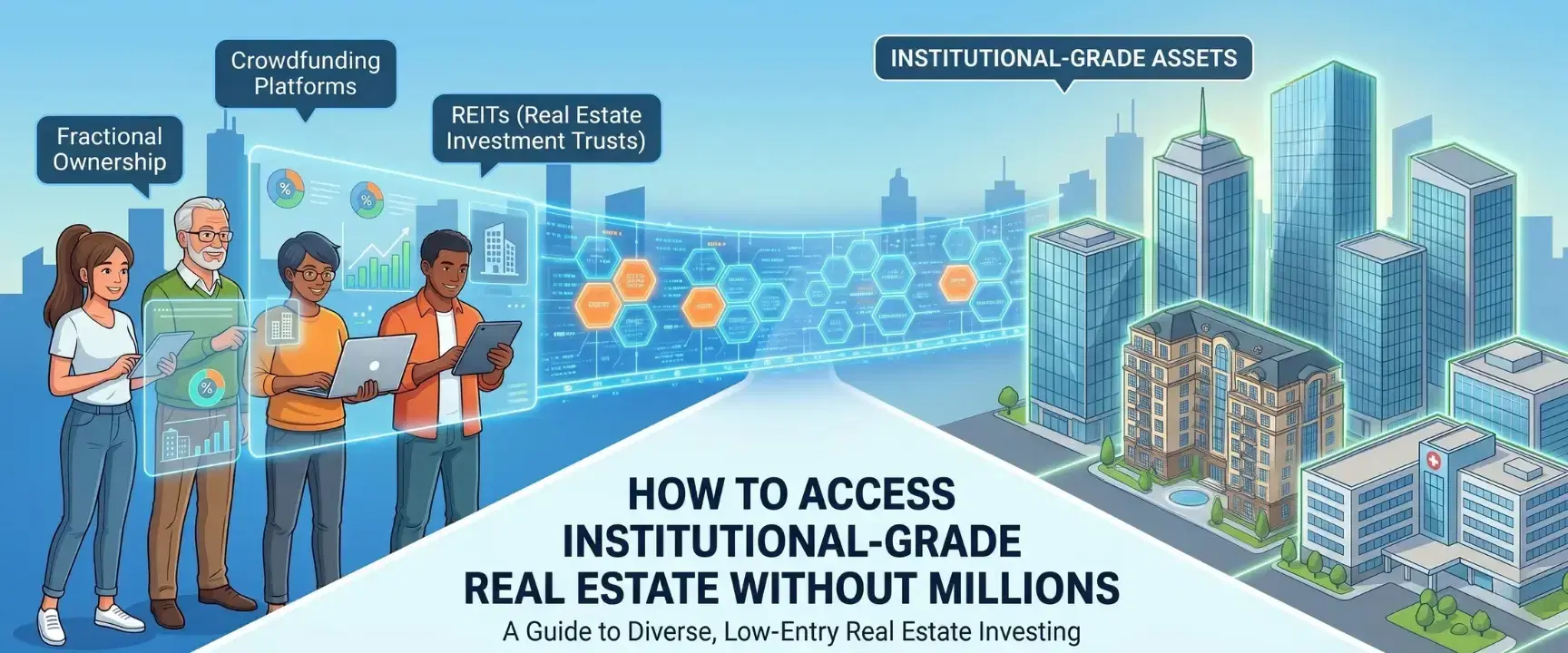
Understanding the Shift in Real Estate Investing
For decades, institutional-grade real estate investing was heavily restricted. It was an asset class exclusively reserved for private equity firms, large institutions, and ultra-high-net-worth individuals. As any US real estate investment guide would show, gaining access historically required overcoming three massive barriers: high capital requirements ranging from $100,000 to over $5 million, limited deal flow locked behind closed networks, and highly complex legal and tax structuring for cross-border investments.
However, that reality has fundamentally shifted. Institutional-grade assets, defined by their strong market fundamentals, high occupancy rates, proven sponsors, and clear downside protection, are no longer hidden behind steep capital walls. Today, the constraint is no longer access, but rather decision-making and action.
The Raveum Paradigm: Democratizing Access
Technology-driven platforms like Raveum are revolutionizing how the world invests in U.S. real estate. Raveum has re-engineered the real estate model by standardizing institutional-grade investing into a format that is structured, transparent, and accessible globally.
Instead of needing millions to buy an entire property, investors can use fractional real estate investing through Raveum to purchase ownership units. This enables individuals to participate in institutionally vetted deals and earn regular rental income alongside capital appreciation.
For international investors, US real estate investment for Indians through Raveum offers a powerful solution to hedge against currency depreciation, earn dollar-denominated passive income, and diversify their portfolios globally within fully compliant cross-border frameworks like the Liberalised Remittance Scheme (LRS).
Every investment is held through dedicated U.S. entities using SEC-aligned structures and strict AML/KYC protocols, ensuring secure, legally protected, and clear ownership.
Featured Opportunity: Harvest Moon Apartments
This shift from theory to reality is perfectly captured by Texas real estate investment opportunities like the Harvest Moon Apartments.
Located in the booming Katy-Houston corridor in Sealy, Texas, Harvest Moon is a 75-unit Class A that reflects the strength of US multifamily real estate investment. Crucially, this is not a speculative, under-construction development; it was built in 2021, is already ~99% occupied, and is generating cash flow from day one.
This property is exactly the type of deal institutional investors prioritize. It utilizes a low-execution-risk value-add strategy (such as installing washer/dryer units to increase rents) and benefits from a highly favorable debt structure, featuring 75% LTV financing, a 6.37% fixed interest rate, and 5-year interest-only payments.
The projected investment metrics are robust and align with private equity benchmarks supporting strong US rental property returns:
20.10% projected IRR
11.80% average annual yield
2.50x equity multiple over a 5-year hold period
Take Action: Download the Raveum App
In the US real estate market 2026 the gap between institutional and individual investors is no longer defined by who has the most capital; it is defined by who acts on access first.
If you are serious about building US real estate investment for Indians dollar-denominated passive income and diversifying into high-quality U.S. real estate, the next step is simple. Download the Raveum App to explore the Harvest Moon Apartments and other active deals directly:. Inside the platform, you will gain immediate access to full deal breakdowns, underwriting, financial models, legal structures, and real-time investment capabilities.
Conclusion
Institutional-grade real estate is no longer confined to large funds and ultra-wealthy investors. With structured platforms like Raveum, US real estate investment for Indians is no longer limited by large capital barriers or traditional access gaps.
Opportunities like Harvest Moon Apartments show how US multifamily real estate investment can combine stability, strong cash flow, and disciplined upside strategies within a transparent framework. The takeaway is clear: the high standards of institutional investing haven't changed, but your access to them has.
Frequently Asked Questions
1. What is institutional-grade real estate investing?
Institutional-grade real estate refers to high-quality, income-generating assets typically acquired by private equity firms and large investors. These assets are backed by strong market fundamentals, high occupancy, experienced sponsors, and structured return models.
2. How can I invest in U.S. real estate without millions?
Investors looking to invest in US property from India can use platforms like Raveum, which offer fractional ownership in U.S. commercial properties
3. What is Harvest Moon Apartments?
US Multifamily real estate investment, Harvest Moon Apartments is a 75-unit Class A multifamily property in Sealy, Texas, located in the Katy-Houston corridor. It is a stabilized, income-generating asset with ~99% occupancy, offering immediate rental income and long-term appreciation potential.
4. What returns can investors expect from Harvest Moon Apartments?
The projected returns include a 20.10% IRR (Internal Rate of Return), an 11.80% average annual yield, and a 2.50x equity multiple over 5 years. These returns are aligned with institutional investment benchmarks.
5. How does this investment generate income?
Returns are generated through monthly rental income distributions, value appreciation through operational improvements, and exit profits after the hold period.
6. Is this a risky investment?
Compared to speculative real estate, this opportunity is considered lower risk due to high occupancy (99%), being a stabilized asset (built in 2021), featuring a fixed, interest-only debt structure, and having conservative downside scenarios.
7. What is the minimum investment amount?
Investments typically start at fractional levels (e.g., ~$100 per share), making institutional-grade assets accessible without large capital commitments.
8. How can Indian investors legally invest in U.S. real estate?
For those asking how to invest in US real estate from India, Indian investors can use the Liberalised Remittance Scheme by the Reserve Bank of India, which allows up to $250,000 per year for overseas investments, subject to compliance with FEMA regulations.
9. Who manages the Harvest Moon Apartments deal?
The deal is managed by Barton Creek Property Group, led by Jon Mendoza, boasting 18+ years of experience, 34 investments executed, $895M+ in total capitalization, and over 7,000 units acquired.
10. How do I access and invest in this deal?
You can explore and invest directly through the Raveum platform by downloading the app to view full deal details, financials, and investment access.
11. What makes this deal different from typical real estate investments?
Unlike speculative or under-construction projects, Harvest Moon offers day-one income generation, a low-risk value-add strategy, and institutional-level underwriting and transparency.
12. What is the exit strategy for this investment?
The investment has a 5-year hold period, after which the property is expected to be sold, generating returns through capital appreciation and profit distribution.
References
- CBRE. (2024). U.S. multifamily market outlook and investment trends. https://www.cbre.com/insights/reports
- Colliers. (2026). Global real estate investment outlook. https://www.colliers.com/en/research
- Federal Reserve Bank of St. Louis. (2025). Interest rates and commercial real estate performance. https://fred.stlouisfed.org
- Internal Revenue Service. (2024). Taxation of foreign investors in U.S. real estate (FIRPTA guidelines). https://www.irs.gov
- JLL. (2025). U.S. multifamily sector overview and capital markets report. https://www.jll.com/en/trends-and-insights/research
- National Multifamily Housing Council. (2025). Multifamily market fundamentals report. https://www.nmhc.org/research-insight
- PwC. (2025). Emerging trends in real estate: United States. https://www.pwc.com/us/en/industries/asset-wealth-management/real-estate.html
- U.S. Census Bureau. (2025). Housing and income statistics for Texas regions. https://www.census.gov
- U.S. Securities and Exchange Commission. (2024). Private placements and Regulation D framework. https://www.sec.gov
- Reserve Bank of India. (2024). Liberalised Remittance Scheme (LRS) guidelines. https://www.rbi.org.in