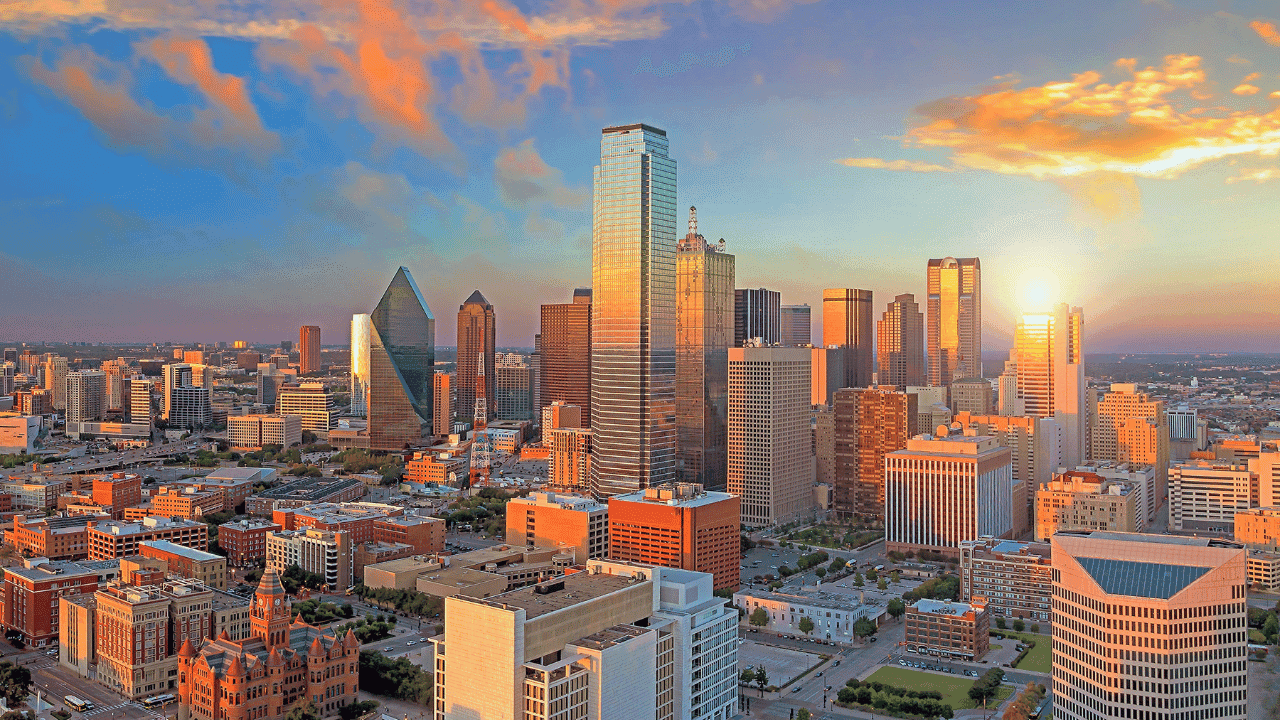
Why Global Investors Continue to Choose Dallas as a Long-Term Real Estate Market
Global capital rarely chases headlines. It follows structure, scale, and repeatable demand. Over the last three decades, Dallas has quietly evolved into one of the most dependable real estate markets in the United States, not because of speculative cycles, but because of its ability to absorb growth, adapt across industries, and sustain income through changing economic environments.
For global investors evaluating U.S. real estate in a post-rate-shock, post-boom world, Dallas stands out not as a high-risk growth story, but as a cash-flow-anchored, institutionally favored market. Its appeal lies less in dramatic appreciation and more in its economic composition: diversified employment, steady population inflows, resilient tenant demand, and an operating environment designed for business continuity.
This is not a market built for timing trades. It is built for holding capital.
Dallas’s Economic Foundations: A Market Built Before the Cycle
Dallas did not emerge as a real estate destination overnight. Its economic base was formed long before technology narratives entered the picture. From the mid-19th century onward, Dallas benefited from two structural advantages: logistics positioning and commercial centrality.
As a rail hub linking agricultural Texas to national markets, Dallas became a natural center for trade, finance, and services. This early commercial role mattered. When oil discoveries accelerated Texas’s economy in the early 20th century, Dallas became the administrative and financial command center for the energy industry, hosting banks, insurers, legal firms, and corporate offices rather than relying on extraction alone.
This distinction shaped the city’s future. Dallas learned early how to grow without being dependent on a single commodity. That legacy still defines the market today.
Key Questions Global Investors Ask About U.S. Real Estate:
1. Why do foreign investors prefer U.S. real estate?
Foreign investors prefer U.S. real estate because it combines enforceable property rights, transparent ownership records, predictable rental income, and one of the world’s most liquid real estate markets. Unlike many countries, the U.S. allows full foreign ownership with strong legal protections, making it attractive for long-term capital preservation and dollar-denominated income.
2. Is real estate in Dallas a good investment?
Yes, Dallas is considered one of the strongest U.S. real estate markets due to population growth, job creation, and economic diversification. The Dallas Fort Worth metro consistently ranks among the top U.S. regions for net migration, rental demand, and commercial absorption, which supports both income stability and long-term appreciation.
3. Which state is best for real estate investment in the USA?
There is no single “best” state, but Texas, Florida, North Carolina, and Arizona are consistently favored by global investors due to population inflows, business-friendly policies, and demand for rental housing. Texas stands out for its scale, absence of state income tax, and depth across residential, industrial, and commercial real estate.
4. What is the 2% rule in real estate and does it still work?
The 2% rule suggests that monthly rent should equal at least 2% of a property’s purchase price. While it can be a quick screening tool, it is largely outdated in institutional markets like Dallas. Professional investors focus instead on net operating income (NOI), tenant quality, lease terms, and cash-on-cash returns.
From Energy to Enterprise Tech: Dallas’s Corporate Evolution
Dallas’s transition into a modern enterprise economy began decades before “tech hubs” became fashionable. Texas Instruments established its headquarters in Dallas in the 1950s, laying the foundation for an engineering driven workforce. In the following decades, telecommunications firms, data services companies, and enterprise technology providers expanded across North Texas.
By the 1990s, the region earned its reputation as the “Telecom Corridor,” attracting global firms in communications, networking, and enterprise systems. Unlike coastal startup ecosystems driven by venture capital volatility, Dallas’s tech evolution was corporate, infrastructure-oriented, and employment-dense.
Today, Dallas supports one of the largest concentrations of corporate technology employment in the U.S. Information technology contributes tens of billions of dollars annually to the regional economy and employs well over 100,000 professionals across software, fintech, cybersecurity, and health technology.
For real estate investors, this matters because corporate tech creates predictable housing demand, longer employment tenures, and sustained occupancy across both residential and commercial assets. Dallas’s tech sector is not about explosive upside, it is about income continuity.
Healthcare and Medical Real Estate: The Market’s Defensive Anchor
While technology cycles attract attention, healthcare remains Dallas’s most durable economic pillar. The Dallas Fort Worth region hosts some of the largest healthcare systems in the United States, including Baylor Scott & White, Texas Health Resources, and UT Southwestern Medical Center.
Healthcare contributes over $50 billion annually to the regional economy and accounts for roughly 15% of all economic activity. More importantly, healthcare employment tends to expand during downturns and remains less sensitive to interest rate cycles.
This stability has direct real estate implications. Medical office buildings, outpatient clinics, and healthcare-adjacent retail generate consistent tenant demand and often operate under longer lease terms. These assets are typically income-first rather than appreciation driven, aligning well with institutional underwriting models.
For global investors seeking defensive allocations within U.S. real estate, Dallas’s healthcare footprint provides a layer of downside insulation that few high-growth markets can match.
Economic Diversification: Dallas’s Structural Risk Advantage
Dallas’s resilience is not tied to any single sector. Beyond technology and healthcare, the region maintains strong exposure to:
- Finance and banking, with major operations from global institutions
- Logistics and transportation, anchored by Dallas/Fort Worth International Airport
- Advanced manufacturing, including automotive and aerospace
- Professional services, legal, consulting, and research
This diversification reduces volatility. When one sector slows, others compensate. From a real estate perspective, this creates a broad tenant base across residential, industrial, retail, and mixed-use assets.
Markets with concentrated economies tend to experience sharper cycles. Dallas’s diversity smooths those edges, making income streams more predictable over time.
Population Growth and Talent Migration: Sustaining Demand
Real estate income ultimately depends on people. Dallas continues to attract population inflows at a scale few U.S. metros can match. The Dallas–Fort Worth metroplex now exceeds 8 million residents and remains one of the fastest-growing regions in absolute numbers.
This growth is driven by multiple factors:
- Employment opportunities across diverse industries
- Relative affordability compared to coastal metros
- Business-friendly regulatory and tax environments
- Strong infrastructure and connectivity
While the pace of migration has normalized from post-pandemic highs, it remains structurally positive. Normalization is not a weakness, it often marks the transition from speculative demand to sustainable occupancy.
For investors, population stability supports rental demand, reduces vacancy risk, and underpins long-term asset performance.
How Dallas Growth Converts Into Real Estate Cash Flow
Dallas’s economic and demographic trends translate into tangible real estate outcomes. Residential rental markets remain active, with average rents supporting steady yields. Commercial assets, particularly industrial, medical, and necessity-based retail continue to attract institutional capital.
Importantly, Dallas has entered a phase where income quality matters more than headline appreciation. This favors:
- Pre-leased assets
- Strong tenant covenants
- Professionally managed properties
- Conservative leverage
Internal Rate of Return (IRR) expectations across Dallas real estate now reflect normalized conditions rather than speculative assumptions. This recalibration aligns with global capital’s preference for visibility over velocity.
Industrial and Logistics: Central Positioning, Not Speculation
Dallas’s role as a national logistics hub remains intact. Its central geography allows efficient distribution across the U.S., and DFW Airport continues to anchor freight, cargo, and commercial activity.
While industrial supply increased in recent years, the market has adjusted through stabilization rather than collapse. Rent growth has moderated, but occupancy across well-located, functional assets remains resilient.
For investors, industrial real estate in Dallas is no longer about aggressive expansion, it is about steady utilization, which supports long-term income rather than short-term appreciation.
Global Capital and Institutional Behavior
Dallas consistently ranks among the top U.S. metros for institutional real estate investment. Pension funds, insurance companies, and private equity firms allocate capital here not because it is fashionable, but because it is repeatable.
Institutions prioritize markets where underwriting assumptions remain valid across cycles. Dallas offers:
- Transparent market data
- Scalable asset opportunities
- Deep transaction liquidity
- Legal and operational clarity
This institutional presence benefits all investors by anchoring valuations and reinforcing market discipline.
Why Dallas Fits Global Portfolios
For global investors, U.S. real estate serves multiple purposes: income generation, currency diversification, and capital preservation. Dallas aligns with each objective.
Dollar-denominated rental income provides exposure to a reserve currency. The market’s diversified economy reduces correlation risk. And the U.S. legal framework offers clarity around ownership, enforcement, and reporting.
Dallas is not positioned as a speculative gateway, it functions as a core allocation market, suitable for long-term portfolio construction.
Access and Structure: The Modern Entry Point
Historically, accessing Dallas real estate required scale, local presence, and operational expertise. Today, structured ownership models allow global investors to participate without direct management burden.
Fractional and pooled structures do not change the asset. They change who can access it. When executed within regulated frameworks, these structures preserve the economics of real estate while reducing friction.
The value lies not in higher returns, but in clarity, compliance, and execution.
A Market Designed for Holding Capital
Dallas is not a market that demands perfect timing. It rewards patience, discipline, and income focus. In a global environment defined by uncertainty, normalization, and recalibration, Dallas offers something increasingly rare: predictability.
For global investors evaluating where to allocate long-term capital in U.S. real estate, Dallas does not promise shortcuts. It offers structure.
And in real estate, structure outlasts cycles.
FAQ's
1. Is Dallas still a good real estate market after the U.S. rate hikes?
Yes. Dallas has transitioned from rapid appreciation to stabilization, favoring income-producing assets. This environment benefits long-term investors focused on cash flow, tenant quality, and capital preservation rather than short-term price growth.
2. Does Dallas real estate rely heavily on one industry?
No. Dallas benefits from a balanced mix of technology, healthcare, finance, logistics, manufacturing, and professional services—reducing dependence on any single sector.
3. How does population growth impact Dallas property investments?
Consistent population inflows support rental demand, stabilize occupancy, and reduce vacancy risk across residential and commercial real estate.
4. Is Dallas more income-focused or appreciation-driven today?
The current market favors income durability over rapid appreciation, aligning well with long-term investment strategies.
5. Can global investors access Dallas real estate without operating properties themselves?
Yes. Structured investment platforms allow participation in professionally managed Dallas properties without direct operational involvement, while preserving real-asset exposure.
6. Which real estate sectors in Dallas are most resilient?
Healthcare-linked properties, industrial/logistics assets, and necessity-based retail tend to perform best due to long leases, essential demand, and lower sensitivity to economic cycles.