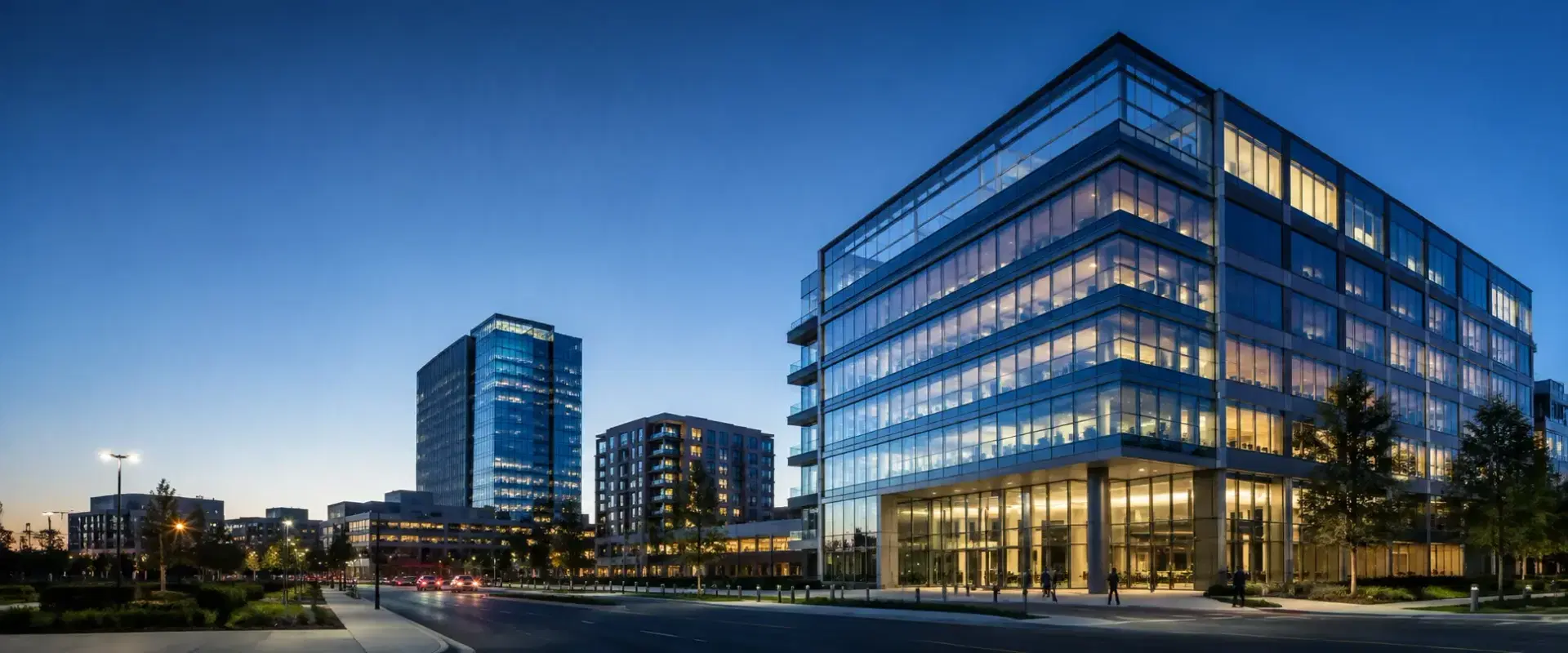
The U.S. real estate market in 2026 is entering the second half of 2026 in a somewhat unusual position.
Interest rates remain high. Inflation has proved harder to control than expected. Geopolitical tensions have pushed up energy prices. Yet investment in U.S. commercial property continues to recover.
CBRE, in its U.S. Real Estate Market 2026 Outlook Midyear Review, expects commercial real estate investment activity to increase by about 16% over 2025 to approximately $605 billion this year. That forecast has broadly remained intact despite a more uncertain economic environment.
For investors following commercial real estate in the USA, the figures suggest that activity is returning despite a more uncertain economic environment
Warehouses, apartments, offices, shopping centres, medical buildings, hotels and data centres are responding differently to changes in the economy. Increasingly, the quality of the property, its location, its tenants and the income it produces matter more than simply owning real estate in a rising market.
For Indian investors trying to understand U.S. real estate, this distinction is particularly useful. "U.S. real estate" is not one market. It consists of several property sectors, each driven by different economic forces.
After Reading This Blog, You Will Understand
- Why the U.S. commercial real estate market is recovering in 2026.
- Which U.S. real estate sectors show stronger opportunities.
- Why property quality, tenants, location and rental income matter.
- What Indian investors should consider before investing in U.S. real estate.
U.S. Commercial Real Estate Investment Is Recovering Despite High Interest Rates
At the beginning of 2026, many investors expected falling interest rates to provide an important boost to property values.
That expectation has changed.
CBRE now expects the U.S. 10-year Treasury yield, an important benchmark for borrowing and property valuations, to remain above 4%, ending the year at around 4.3%. Inflation, meanwhile, is forecast at approximately 3.6% by the fourth quarter, considerably higher than initially expected.
Higher interest rates matter because commercial properties are frequently purchased with borrowed money. More expensive debt can reduce the price investors are willing to pay for a building.
Yet the broader economy has remained relatively resilient. CBRE forecasts U.S. GDP growth of about 2.1% in 2026, similar to 2025, with investment in artificial intelligence and technology providing an important source of economic activity.
For property investors, this produces an important shift.
CBRE had originally expected property "capitalisation rates", or cap rates, to decline during 2026. Cap rates are broadly a measure of the income generated by a property relative to its value. Falling cap rates generally support higher property prices.
CBRE now expects them to remain broadly stable through the remainder of the year, with some compression potentially returning in 2027. Consequently, rental and operating income is likely to play a larger role in investment returns.
In simple terms, investors may have less room to depend on rising property prices and more reason to examine the income a building can actually generate.
Understanding these differences is important when assessing the U.S. real estate market in 2026, because performance varies considerably across property types
U.S. Office Real Estate Is Recovering But Quality Matters
Few parts of commercial real estate have experienced as much disruption as offices.
Remote and hybrid work left large amounts of office space vacant after the pandemic. In 2026, however, the picture is beginning to change.
CBRE expects office leasing to increase during the second half of the year, with technology companies becoming an important source of demand. Technology accounted for around 21% of office leasing activity in the first half of 2026, and 64% of technology companies surveyed by CBRE said they expect to increase their office footprint over the next three years.
The recovery also coincides with unusually little new office construction.
Demolitions and conversions of old office buildings are now exceeding new completions. CBRE expects U.S. office vacancy to finish 2026 at about 18%, while rent growth is forecast at 2.7% year-on-year.
But the headline figures hide an important divide.
Modern, well-located offices are performing considerably better than older buildings. Companies are increasingly competing for higher-quality space, particularly in major employment and technology centres.
For investors, the lesson is straightforward: an "office recovery" does not automatically make every office building attractive.
U.S. Industrial Real Estate Benefits From Manufacturing and Logistics Demand
Warehouses and industrial buildings remain one of the stronger areas of the U.S. real estate market in 2026.
Demand is being supported by several long-term changes in the American economy: companies are bringing some manufacturing closer to home, businesses are outsourcing logistics to specialist operators, and investment in advanced manufacturing and digital infrastructure continues to increase.
CBRE has doubled its forecast for industrial leasing growth in 2026, raising it from 5% to 10%. Leasing by third-party logistics companies is up 19% year-on-year, while manufacturing leasing has increased 27%.
At the same time, construction of large warehouses has slowed considerably.
CBRE expects approximately 260 million sq. ft. of industrial space to be completed in 2026, a decade low. Limited construction combined with healthy tenant demand could support rents for modern industrial properties.
Here too, however, there is a divide.
Companies increasingly prefer modern warehouses with suitable ceiling heights, loading facilities, power and transportation access. Older industrial buildings can remain vacant even when the broader warehouse market is healthy.
The age and functionality of the building therefore matter almost as much as the sector itself.
U.S. Retail Real Estate Is Stronger Than Many Investors May Expect
The rise of e-commerce once led to widespread predictions that physical retail property would steadily decline.
The current U.S. market suggests a more complicated outcome.
Very little new retail space has been constructed in recent years. At the same time, grocery stores, discount retailers, service businesses, fast-casual restaurants and quick-service restaurants continue to require physical locations.
The result is limited availability in many markets.
CBRE expects retail property fundamentals to remain healthy, helped by historically low levels of new construction. Dallas, Phoenix and Houston are among the markets seeing particularly strong absorption of newer retail space.
Well-located open-air centres and grocery-anchored properties are also expected to benefit from constrained supply.
This illustrates a broader change in retail property. Investors are increasingly distinguishing between properties supported by everyday consumer needs and those dependent on discretionary shopping or weaker locations.
U.S. Multifamily Real Estate Enters a More Stable Phase
Apartments remain one of the largest segments of U.S. commercial real estate.
For investors considering U.S. multifamily real estate investment, the changing balance between supply, occupancy and rent growth is particularly important
The sector went through a significant construction cycle in recent years, particularly across high-growth Sun Belt markets. That increase in supply temporarily reduced landlords' ability to raise rents.
The market is now becoming more balanced.
CBRE expects average U.S. apartment rents to grow approximately 1.4% in 2026, with vacancy around 4.9%. Landlords are still using incentives to maintain occupancy, while strong tenant renewal rates are helping protect property income.
Performance varies considerably by location.
Supply-constrained markets including Seattle, the San Francisco Bay Area, Chicago and Boston currently have stronger long-term rent-growth forecasts. Some Sun Belt cities are taking longer to absorb the large amount of housing constructed during the recent development cycle.
This is another reminder that population growth alone does not determine property performance. New supply, employment growth and the price at which a property is acquired also matter.
U.S. Data Center Real Estate Is Being Reshaped by Artificial Intelligence
No property sector illustrates the impact of artificial intelligence more clearly than data centres.
AI systems require enormous computing capacity and computing capacity requires buildings, specialised equipment and, above all, electricity.
Demand has become so strong that CBRE has raised its expected pre-leasing rate for U.S. data centres under construction to 80% from an earlier forecast of 70%.
That has made data centres one of the most closely watched sectors in the current U.S. real estate forecast
The principal constraint is increasingly power rather than land.
In some markets, obtaining sufficient electricity from the grid can take more than a decade. Developers are therefore exploring markets where power can be delivered sooner, including parts of Texas, Pennsylvania, Indiana, Michigan and North Carolina.
But strong demand does not eliminate risk.
Large data centres are extraordinarily expensive to develop, while the financial strength of tenants and operators can vary substantially. CBRE estimates construction costs for the most demanding facilities at roughly $14 million to $16 million per megawatt.
AI may therefore create one of real estate's strongest structural growth stories, but it is also creating one of its most capital-intensive ones.
Healthcare Real Estate Gains From Demographic Demand
Healthcare property presents a different investment case.
Demand is less directly linked to economic cycles and more closely connected to demographics and the continuing need for medical services.
Vacancy in U.S. medical outpatient buildings fell to approximately 9.8% by midyear 2026, according to CBRE. Limited construction and steady demand from healthcare providers are expected to keep vacancy broadly stable.
Texas, Florida and North Carolina are among the markets expected to perform relatively well, supported by population growth and healthcare demand.
Another interesting development is the conversion of conventional properties into healthcare facilities. CBRE says 43% of medical outpatient conversions originate from retail buildings and another 42% from traditional offices.
For investors, this shows how changing consumer and demographic patterns can alter the economic use of real estate over time.
Hotels and Life Sciences Show a More Mixed U.S. Real Estate Outlook
The hotel industry is also improving.
CBRE has raised its forecast for U.S. hotel revenue per available room, or RevPAR, growth to 2.5% in 2026, compared with an earlier forecast of 1.2%. Recovery in domestic business travel and conventions is providing much of the improvement.
Luxury hotels are performing considerably better than economy properties, reinforcing the wider theme of divergence within property sectors.
Life-sciences real estate remains more challenging.
Demand for laboratories is beginning to improve, helped by biotechnology employment and capital-market activity, while new construction has fallen sharply. But vacancy remains high. CBRE expects lab vacancy to decline only modestly to approximately 22.5%, while asking rents are expected to continue falling during 2026.
A recovering sector, therefore, does not necessarily mean that supply-and-demand conditions have fully normalised.
What the 2026 U.S. Real Estate Market Outlook Means for Investors
The most important message from the U.S. commercial real estate market in 2026 may be less dramatic than either optimists or pessimists would prefer.
The market is recovering, but selectively.
CBRE expects investment volumes to grow across the major property categories, including approximately 20% for multifamily, 17% for retail, and 16% each for office and industrial property. Yet higher borrowing costs mean that investors have fewer reasons to assume that simply buying property and waiting for interest rates to fall will produce strong returns.
Property income, tenant quality, lease duration, location, building quality and the balance between local demand and new supply are becoming increasingly important when assessing U.S. rental property returns.
For an Indian investor evaluating U.S. real estate, this may be the more useful way to view the market.
The question is not simply whether American property is rising or falling.
It is which property, in which market, occupied by which tenant, producing what income, and purchased at what price.
In a market where different property sectors are moving in different directions, those distinctions matter more than the headline.
This is also where platforms such as Raveum fit into the broader picture. Raveum enables Indian investors to evaluate and participate in selected U.S. commercial real estate opportunities while navigating the practical requirements of cross-border investing.
Frequently Asked Questions (FAQs)
1. Is the U.S. commercial real estate market improving in 2026?
Yes. The market is showing encouraging signs of recovery, with investment activity picking up across several property sectors. Improving leasing demand and limited new supply in some segments are creating a more constructive environment for long-term investors.
2. Which U.S. real estate sectors look promising in 2026?
When considering the best U.S. real estate investment opportunities in 2026, industrial, retail, multifamily, healthcare and data centres continue to show attractive fundamentals, while high-quality office properties are also seeing renewed demand. Each sector offers different opportunities depending on location, tenant demand and supply conditions.
3. Why is rental income important for U.S. real estate investors?
In the current market, steady rental income can be an important source of returns. Properties with strong tenants, healthy occupancy and well-structured leases may offer investors greater income visibility alongside the potential for long-term capital appreciation.
4. What is supporting the U.S. commercial real estate market in 2026?
The market is benefiting from steady economic activity, improving leasing demand and limited new construction in several sectors. These factors are helping support rental income and creating selective opportunities for investors across industrial, retail, multifamily and other commercial real estate segments.
5. What makes U.S. commercial real estate relevant for Indian investors?
U.S. commercial real estate can give Indian investors access to a large and diversified global property market, along with potential dollar-denominated income and geographical diversification. Platforms such as Raveum can also make it easier to evaluate and access selected U.S. commercial real estate opportunities.