INVEST IN U.S. REAL ESTATE FROM INDIA
Start Earning Rental Income From Day One
Indian residents can legally own a share of an income-producing U.S. property through the RBI Liberalised Remittance Scheme. You earn rent in dollars, and Raveum handles the paperwork with you, step by step.REGULATED & COMPLIANT




REGULATED & COMPLIANT
01 · The route
How to invest in U.S. real estate from India, in 5 steps
Most of the paperwork is in steps one and three. That is where first-time investors want the detail, so we spell it out.
Step 1
Check your eligibility and LRS limit
Raveum checks that you can invest and how much of your US$250,000 yearly LRS limit is still free. Money you have already sent abroad this year, for education, travel or gifts, uses up the same limit.

Step 2
Select the property and read the documents
Review the market, tenant, lease term, debt and business plan. The offering documents set out fees, holding period, distribution mechanics and the full risk factors.
Step 3
Remit through your authorised dealer bank
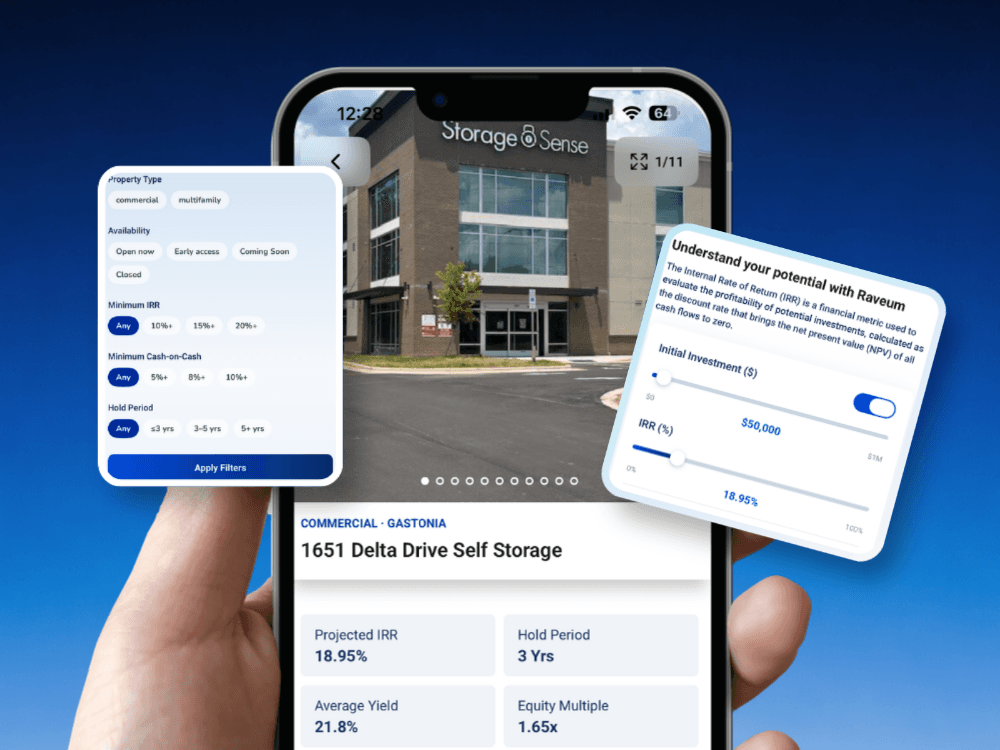
You submit Form A2 and an LRS declaration with beneficiary details and source of funds. Raveum prepares the FEMA-aligned paperwork with you. Remittance is supported by our banking partner, Kotak Mahindra Bank.
Step 4
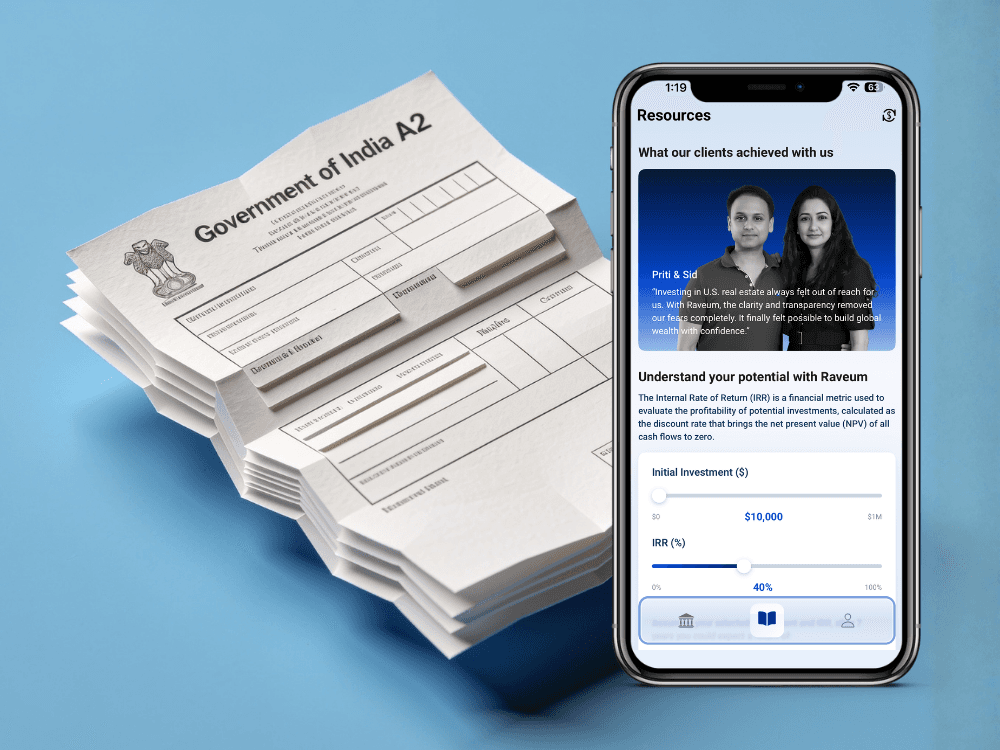
Take ownership through the U.S. entity
Your dollars purchase an interest in a property-specific U.S. entity, normally a limited liability company. The interest is recorded in your name and you receive ownership documentation.

Step 5
Collect distributions and report annually
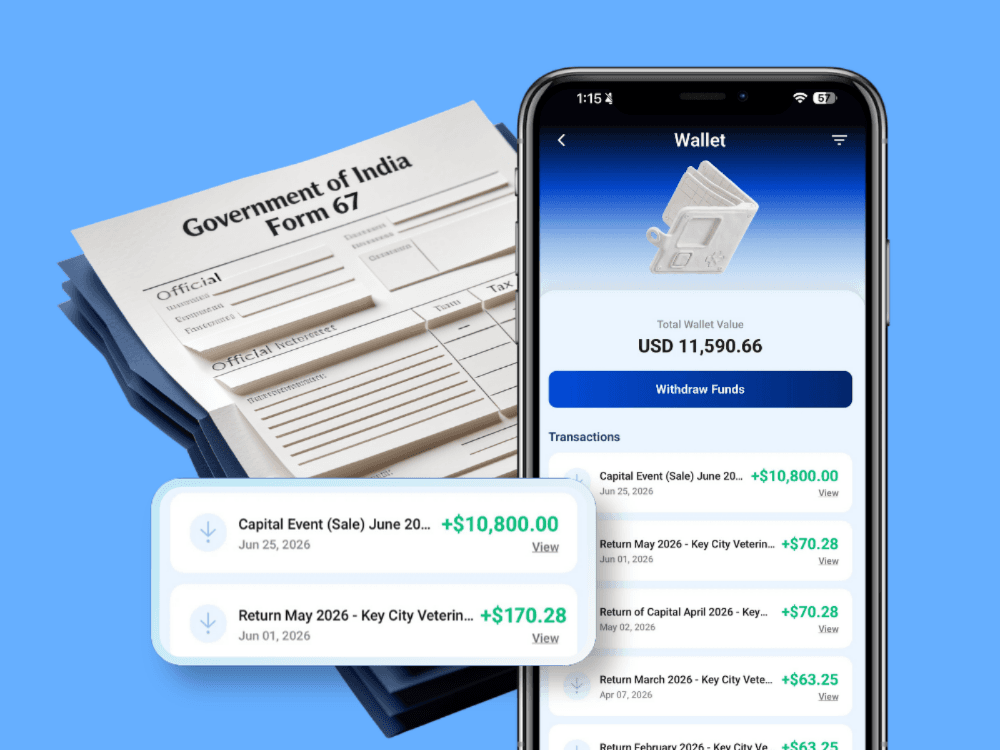
Distributions are paid in U.S. dollars according to the offering terms. In India you disclose the holding in Schedule FA and foreign income in Schedule FSI, and claim foreign tax credit through Form 67 where applicable.
02 · Ownership
What you actually own
You are not on a deed. You hold an interest in the company that owns the building. That distinction drives your rights, your reporting and your exit.
YOU
INDIA · LRS
CO-INVESTORS
SPONSOR
MANAGER
U.S. LLC
One property, one entity
THE PROPERTY
Income-producing U.S. real estate
A property-specific entity.
Held in its own U.S. LLC, not commingled with other assets.
Your interest, in your name.
Ownership percentage, income share and rights set out in the documents.
The sponsor operates.
Financing, property manager, leasing and investor reporting. You do not manage tenants.
Cash flows by the waterfall.
Rent in, expenses and debt paid, available cash distributed by the agreed structure.
Exit is on sale, not on demand.
No ready secondary market; assume you hold until sale or refinance.
03 · Documents
What your bank will ask for
Gathering these before you start is the single biggest time saver. Tick them off as you go.
04 · Tax and the DTAA
DTAA means you are taxed once, not twice
Your rental income is taxed in the U.S., because the property is there, and it is also reportable in India, because you are an Indian resident. The India-U.S. Double Taxation Avoidance Agreement (DTAA) makes sure the same income is not fully taxed twice.
The U.S. taxes it first
The rent is earned in the U.S., so U.S. tax applies to the income from the property.
India counts it too
As an Indian resident, you also report this foreign income on your Indian return.
The DTAA gives you credit
You subtract the U.S. tax you already paid from your Indian tax, using Form 67, so you are not billed twice for the same rupee.
4.1You receive rent
In the United States
You pay U.S. tax on the rental income. Your structure gives you a U.S. tax document showing your share and any tax already withheld.
In India
Report it as foreign income in Schedule FSI.
4.2While you hold it
In the United States
Usually no separate yearly U.S. filing for most fractional investors.
In India
Declare the foreign asset in Schedule FA every year you hold it.
4.3When it is sold
In the United States
FIRPTA (a U.S. rule for foreign owners) may hold back some tax at sale. This is an advance, not your final bill.
In India
Report the gain and claim DTAA relief for the U.S. tax you already paid.
4.4Claiming DTAA credit
In the United States
Your final U.S. position is settled in your U.S. filing.
In India
Claim credit for the U.S. tax under the DTAA using Schedule TR and Form 67, within the deadline.
General information only, not tax advice. Your position depends on your own facts and structure. Use advisers qualified in both India and the U.S. before you invest.
Your allowance
How much LRS headroom do you have left?
The US$250,000 covers every eligible overseas remittance in the financial year, not only investments. Enter what you have already sent since 1 April.
$250,000
approx ₹2,20,00,000
Below the ₹10 lakh TCS threshold
Indicative only. The limit applies per resident individual per financial year, 1 April to 31 March. TCS thresholds and rates are set by the Finance Act and change with Budget cycles. The exchange rate shown is an illustrative default, not a live rate. Confirm your position with your authorised dealer bank and your tax adviser before remitting.
05 · FAQs
Clear answers before you commit
The questions Indian investors ask us most, before their first remittance.
06 · Dig deeper
The guides, in detail
Long-form guides that go deeper on everything covered on this page.




This page is general information, not legal or tax advice. Nothing here determines your tax residency, your residential status under FEMA, your U.S. person status, your accredited investor status or your eligibility to invest. Those are questions of law that depend on your own circumstances, and they are settled by the applicable rules and by your own professional advisers, not by Raveum. Descriptions on this page reflect our understanding as at August 2026 and may change. Take your own legal and tax advice before you act on anything you read here.
See a live opportunity before you commit anything
All investing involves risk, including loss of capital. Fractional real estate is illiquid, holding periods are estimates and distributions are not guaranteed. Interests are offered to Indian investors under SEC Regulation S and are not offered to the general public. Review the complete offering documents and consult qualified Indian and U.S. advisers before investing.