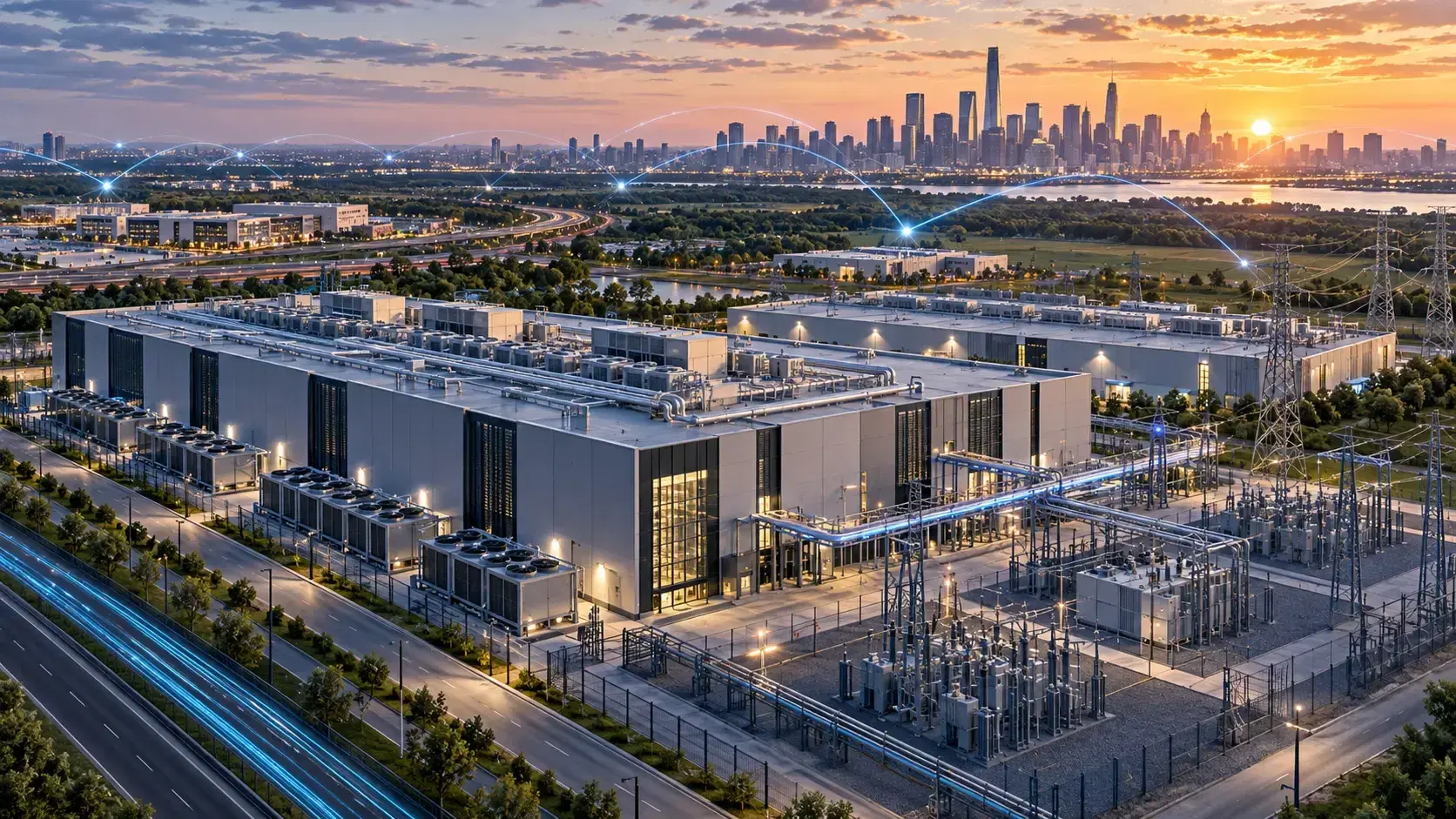
Less than two years ago, this 189,000-square-foot property near Chicago was an ordinary warehouse. It later sold for about $750 million after being converted into a data center.
That jump in value says something important about the US real estate market 2026: artificial intelligence is beginning to change what makes certain buildings and parcels of land valuable.
AI may be built in software, but its expansion depends on physical assets. The servers running AI models require data centers, while those facilities depend on land, fibre networks, cooling systems and large, reliable supplies of electricity.
As investment in AI increases, demand for this infrastructure is reshaping parts of the property market. Industrial sites with the right combination of power, connectivity and location are gaining new potential as the digital economy expands.
The Elk Grove Village transaction is one of the clearest examples of how quickly that shift can happen.
After reading this blog, you will understand:
- How AI is creating new demand for U.S. real estate
- Why data centers are becoming more important
- How power access is influencing site value
- Why industrial real estate and data centers are overlapping
- What this shift means for the U.S. real estate market in 2026
Inside the $750 Million Data Center Deal
GI Partners acquired the Elk Grove Village data center for about $750 million, a transaction that shows how digital infrastructure is becoming a more important part of U.S. commercial real estate.
The value of these assets increasingly depends on more than the building itself. Less than two years earlier, the property had been a warehouse before being converted into a data center.
What changed was the role the building could play. Rising demand for cloud computing, digital services and artificial intelligence created a need for properties capable of supporting large amounts of computing power.
The shift shows how changes in technology are beginning to reshape the way certain properties are used and valued.
How an Ordinary Warehouse Became Digital Infrastructure
Warehouses and data centers serve very different purposes, but they often depend on similar types of real estate: large sites, strong infrastructure and access to major business markets.
For data centers, power becomes the defining requirement. A suitable site needs reliable access to large amounts of electricity, along with the fibre connectivity and technical infrastructure needed to support continuous computing.
Elk Grove Village had those advantages. The Chicago area is already an established data-center market, giving operators access to both infrastructure and a large business base.
This deal has shown how an existing industrial property can take on a new role when the surrounding infrastructure supports the needs of the digital economy.
How AI Is Creating Demand for U.S. Commercial Real Estate
AI is often described through software, chips and computing models, but its growth depends on a large physical network.
Every AI application requires computing capacity, and that capacity sits inside data centers. Those facilities rely on servers, cooling systems, fibre connections, backup infrastructure and a continuous supply of electricity.
As companies invest more heavily in AI, demand is growing for the real estate that can support this infrastructure.
Major research firms are already reflecting this shift in their U.S. real estate forecast and market outlooks. CBRE, ULI, PwC, Cushman & Wakefield and J.P. Morgan Asset Management have all identified data centers, power availability and AI-related infrastructure as increasingly important forces in the property market.
This is where the digital economy becomes a real estate story, creating demand for land, buildings and the infrastructure that supports them.
Why Power Is Becoming More Important in Data Center Real Estate
For traditional real estate, location has long been shaped by access to customers, roads, labour and space. Data centers add another factor to that equation: power.
Large facilities can require enormous amounts of electricity, making reliable access to the grid a central part of site selection. In some U.S. markets, the availability of that power can influence how quickly a project moves forward and whether a site is suitable at all.
That is increasing interest in what the industry calls powered land: sites where electrical capacity is already available or can be secured.
For developers and investors, this means the infrastructure connected to a property is becoming part of its value. A well-located site with strong power access can support a very different range of uses from one without it.
Where Data Centers and Industrial Real Estate Are Starting to Overlap
Data centers and industrial properties often compete for the same basic ingredients, such as large parcels of land, strong infrastructure and access to major cities.
What is changing is the weight given to power and connectivity. A site that works as a warehouse can become even more valuable when it also has the electricity and fibre capacity needed for digital infrastructure.
That is creating a closer overlap between data centers and U.S. commercial real estate, particularly in industrial markets where land can support more than one use.
The opportunity is increasingly shaped by the combination of location, power, connectivity and local demand. That is widening the range of buyers and uses that certain industrial sites can attract.
What Makes a Good U.S. Real Estate Site Today
Location remains central to commercial real estate, but the qualities that make a site attractive are becoming more varied.
For data centers, power availability, fibre connectivity and technical infrastructure can influence what a property is capable of supporting. These factors are beginning to sit alongside more traditional considerations such as access, demand and surrounding development.
That is changing how some sites are evaluated. A property is increasingly considered not only for its current use, but also for the kinds of economic activity it may be able to support over time.
The Elk Grove Village example brings that shift into focus. Its value came not simply from the building itself, but from the infrastructure and market conditions that allowed the site to serve a different purpose.
What This Shift Means for the U.S. Real Estate Market in 2026
The Elk Grove Village transaction offers a useful way to read the US real estate market 2026. The value of certain properties is becoming more closely linked to the infrastructure, energy access and technology demand around them.
For investors, that makes the surrounding economic ecosystem just as important as the asset itself.
Understanding where capital is moving, which industries are expanding and what infrastructure they require can provide a clearer view of how demand may develop over time.
For the growing US real estate market in 2026, this shift is becoming more relevant as the lines between traditional property sectors and digital infrastructure continue to blur. A building may still be classified as industrial real estate, but its use and value can increasingly be shaped by technology, energy and connectivity.
AI is no longer only a story about software companies and chips. Its growth is beginning to influence the physical economy as well, and real estate is one of the clearest places where that connection is becoming visible.
The strongest way to read U.S. real estate today is therefore to look beyond the building itself and understand the demand developing around it.
Raveum's September 2026 U.S. Real Estate Report explores this wider market, including where investment capital is moving, the sectors attracting attention, important policy developments and the major transactions shaping U.S. commercial real estate.
Read the full September 2026 U.S. Real Estate Report for the broader picture.
Frequently Asked Questions
1. Is AI replacing real estate?
AI is not replacing real estate. In many cases, it is creating new demand for it. AI systems need data centers, and data centers need land, buildings, electricity, cooling systems and fibre connections. As AI grows, more physical infrastructure is required to support it.
2. How is AI changing the U.S. real estate market?
AI is changing the way some industrial properties are used and valued. Data centers are creating demand for large sites with strong power access, reliable infrastructure and good connectivity. This is bringing technology and commercial real estate much closer together.
3. Why are data centers becoming important in U.S. real estate?
Data centers support cloud computing, digital services and artificial intelligence. Their growth is increasing demand for suitable buildings, industrial land and electricity. In some markets, access to power is becoming as important as location.
4. Can a warehouse be converted into a data center?
Yes, some warehouses can be converted into data centers when the location, building structure, power supply and fibre connectivity are suitable. The Elk Grove Village property near Chicago is one example of a warehouse that was converted into a large data center.
5. What is powered land in real estate?
Powered land is land where significant electrical capacity is already available or can be secured. This is especially important for data centers because they require large and continuous amounts of electricity. Power access can therefore increase the development potential of a site.
6. Is industrial real estate benefiting from the growth of AI?
Yes, in some markets. Data centers and traditional industrial properties often compete for similar land. As AI infrastructure grows, industrial sites with strong power access, fibre connectivity and good locations can attract interest from both logistics users and data-center developers.