The number of new international students arriving at U.S. universities fell 18% in the 2025/26 academic year, to 228,123, according to the Open Doors 2026 report from the Institute of International Education released on 16 November 2026. For anyone weighing student housing investment, that figure deserves attention, because student housing is the one property type whose tenants come almost entirely from enrolment at a single university.
India remains the largest source of international students in the U.S., with 339,435 students, yet the number of Indian graduate students fell 34% to 116,609. A building near a campus that filled its beds with those master's students can feel such a change within one leasing season. For an Indian investor, the more useful question is therefore how much one property depends on the particular students it houses, a question that belongs alongside the wider guide to U.S. property types and market conditions.
What Student Housing Investment Means in the U.S.
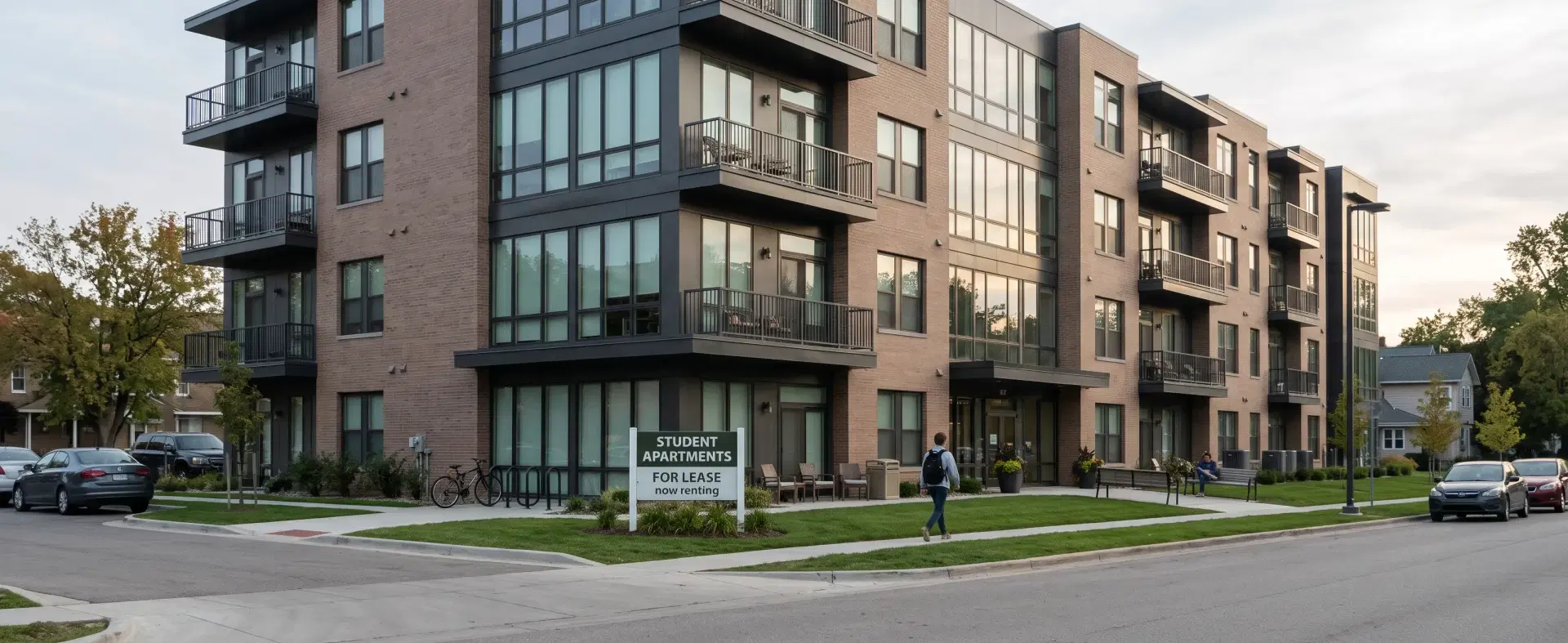
Student housing investment usually means owning purpose-built student housing, which is apartment buildings designed and run for university students near a campus. These buildings differ from dormitories, which universities own and run on their own land. Purpose-built properties are privately owned, often by a sponsor, meaning the real estate firm that buys and manages the asset, with outside investors providing much of the equity.
Demand exists because universities house only part of their students. At the 175 universities that RealPage tracks, on-campus housing covers only about a fifth of enrolment, according to the Emerging Trends in Real Estate 2027 report by PwC and the Urban Land Institute. The remaining students rent in the private market, either in ordinary apartments or in buildings built for them.
How a Student Housing Property Collects Rent
The leasing model is what makes student housing a separate category. Many properties lease by the bedroom rather than by the apartment, as the commercial real estate firm Northmarq describes it, so four students sharing a flat each sign a separate lease for their own bed. Leases are usually aligned with the academic calendar, and many landlords ask for a parent's guarantee or the full year's rent in advance, as Miami University in Ohio tells its students.
This model has strengths and costs. Separate leases mean one student leaving does not empty a whole apartment, and a parent's guarantee adds a second person responsible for the rent. Even so, a large share of units turns over at the same time each year, so leasing, cleaning and marketing are packed into a few weeks. Northmarq also notes that if pre-leasing falls short before the academic year, there may be little time to recover occupancy before term begins.
Pre-leasing is the measure the sector watches most closely. It is the share of beds already signed for the coming academic year. Across the Yardi 200, the group of universities that Yardi Matrix tracks, pre-leasing for autumn 2026 reached 93% in August, the firm said in its September 2026 student housing report. The same report said advertised rents had slipped and that many universities were seeing a drop in international enrolment.
What the Open Doors Figures Change for Student Housing Demand
The Open Doors data covers the academic year that ended before most autumn 2026 leases were signed. Total international enrolment fell 3% to 1,146,163, but the decline was concentrated among new and graduate students. Master's enrolment dropped 22%, while undergraduate numbers were almost flat.
A preliminary survey points the same way. The Institute's Fall 2026 Snapshot, drawn from more than 800 institutions, showed a further 9% fall in total international enrolment this autumn and a 15% fall in new students, as reported by Forbes and the Free Press Journal on 16 and 17 November 2026. These are early survey results and may change when final data is published.
Not every figure moved down. Optional Practical Training, the work period that follows a degree, rose 14% to 335,785, and the number of Indian students on it rose 27% to 182,201. These graduates are still counted as international students, but they have finished their courses and are working, which suggests that many no longer rent a bed near campus. A rising headline total for one country can therefore hide a falling number of students looking for student housing.
Why One Campus Matters More Than the National Figure
National numbers average together universities with very different students. A large public university that draws mostly domestic undergraduates may see little change from the Open Doors figures, while a campus whose growth came from international master's programmes may see a sharp drop in new tenants. Yardi Matrix described student housing performance in August 2026 as uneven, citing concentrated new supply in several large markets and declining international enrolment.
New supply is the second local factor. RealPage counted 32,815 new beds delivered in 2025-2026, down from 34,773 the year before, according to the Emerging Trends report. Those beds are not spread evenly. In February 2026, Yardi named Purdue, Indiana University and the University of Tennessee among schools trailing the previous year's pre-leasing pace after absorbing significant new supply.
Enrolment also has a longer horizon. The number of U.S. high school graduates peaked in 2025, and WICHE, a regional higher education body, projects a 13% decline by 2041, as cited in the same report. RealPage expects enrolment growth across its 175 universities to ease to 1.5% in 2026-2027, from 2.0% in 2025. Both are forecasts by named sources, and either could prove wrong. An investor weighing a student housing deal can ask the sponsor for evidence on these points.
- The share of the university's students who are international, and the share who are graduate students.
- The pre-leasing pace for the coming year against the same date in earlier years.
- New beds under construction or approved within walking distance of the campus.
- How many leases carry a parent's guarantee or advance payment.
- The university's own housing plans, including any rule that first-year students live on campus.
Risks and Limits of Student Housing Investment
Student housing carries the general risks of private real estate and some of its own. An investor can lose capital if the property's value falls, and distributions may be reduced or not paid if beds stay empty or costs rise. Most buildings carry a mortgage, so a weak leasing season can strain loan payments and make refinancing harder.
The specific risks follow from the model. A property depends on one university, so a change in that university's enrolment, visa trends or housing policy flows directly into occupancy. The leasing season is short, and a poor season can leave beds empty for a full academic year. Turnover is high, which raises repair and marketing costs, and new buildings near campus can draw tenants away quickly.
Two further limits apply to Indian investors. A stake in a private property is illiquid and usually cannot be sold before the sponsor sells the building. Rent is earned in dollars, so the rupee value of any distribution rises or falls with the exchange rate, as the guide to dollar assets for Indian investors explains.
Judging Student Housing One Campus at a Time
The Open Doors release shows how quickly one input into student housing can change. Indian students remain the largest international group in the U.S., yet the number of Indian graduate students fell by about a third in a single year. For a building that relied on them, that shift matters more than any national occupancy figure.
The clearest reading is that student housing behaves like a local business tied to one institution. Enrolment mix, pre-leasing, nearby supply and the strength of each lease decide most of the outcome, and these questions sit within the broader checks on U.S. property types and market conditions. A sound national average offers little comfort to a building next to the wrong campus.
Indian residents who invest in private U.S. real estate typically send money under the Liberalised Remittance Scheme, within its limit of US$250,000 for each financial year. The steps from remittance to tax reporting are set out in the complete guide to investing in U.S. real estate from India. Eligible investors can review how investing in U.S. real estate from India works on Raveum, including the property, sponsor, ownership structure, fees, risks and offering documents for each opportunity.
Frequently Asked Questions
What is student housing investment?
Student housing investment means owning, or holding a share in, apartment buildings built and run for university students near a campus. These purpose-built properties are privately owned, unlike university dormitories. Rent usually comes from individual leases for each bed, tied to the academic year, and demand depends heavily on enrolment at the nearby university.
How is student housing different from a normal apartment building?
Student housing usually leases by the bed rather than by the apartment, so each student signs a separate lease. Leases follow the academic calendar, many require a parent's guarantee, and most units turn over at the same time each year. An ordinary apartment building leases whole units to households on dates spread through the year.
Is student housing a risky investment?
Yes, student housing carries real risks. A property depends on one university, so falling enrolment, visa changes or new buildings nearby can leave beds empty for a full academic year. Turnover raises costs, most properties use debt, and a private stake is hard to sell early. Investors can lose capital, and distributions may stop.
How does lower international student enrolment affect student housing?
The effect depends on the campus. Universities whose growth came from international graduate students, especially in master's programmes, can see fewer new tenants when visa issuance or applications fall. A campus that mainly draws domestic undergraduates may see little change. Investors should ask the sponsor for the university's student mix rather than rely on national totals.
What does pre-leasing mean in student housing?
Pre-leasing is the share of beds already signed for the coming academic year, measured months before students arrive. Owners and lenders compare it with the same date in earlier years to judge demand. Across the Yardi 200 universities, pre-leasing for autumn 2026 reached 93% in August 2026, according to Yardi Matrix.
Can Indian residents invest in U.S. student housing?
Indian residents can invest in private U.S. real estate offerings that admit non-U.S. persons under SEC Regulation S, sending money under the Liberalised Remittance Scheme. Each offering sets its own terms, so investors should check the property type, sponsor, structure, fees and risks, and discuss the tax position with their CA before remitting.
This article is for general education only and is not investment, tax or legal advice. Rules change and depend on individual circumstances. Investing in private real estate involves risk, including loss of capital, illiquidity, falling property values, distributions not being paid and currency movements. Participation is limited to non-U.S. persons under SEC Regulation S and verified U.S. accredited investors under Regulation D Rule 506(c), and offerings on Raveum are not open to the general public.