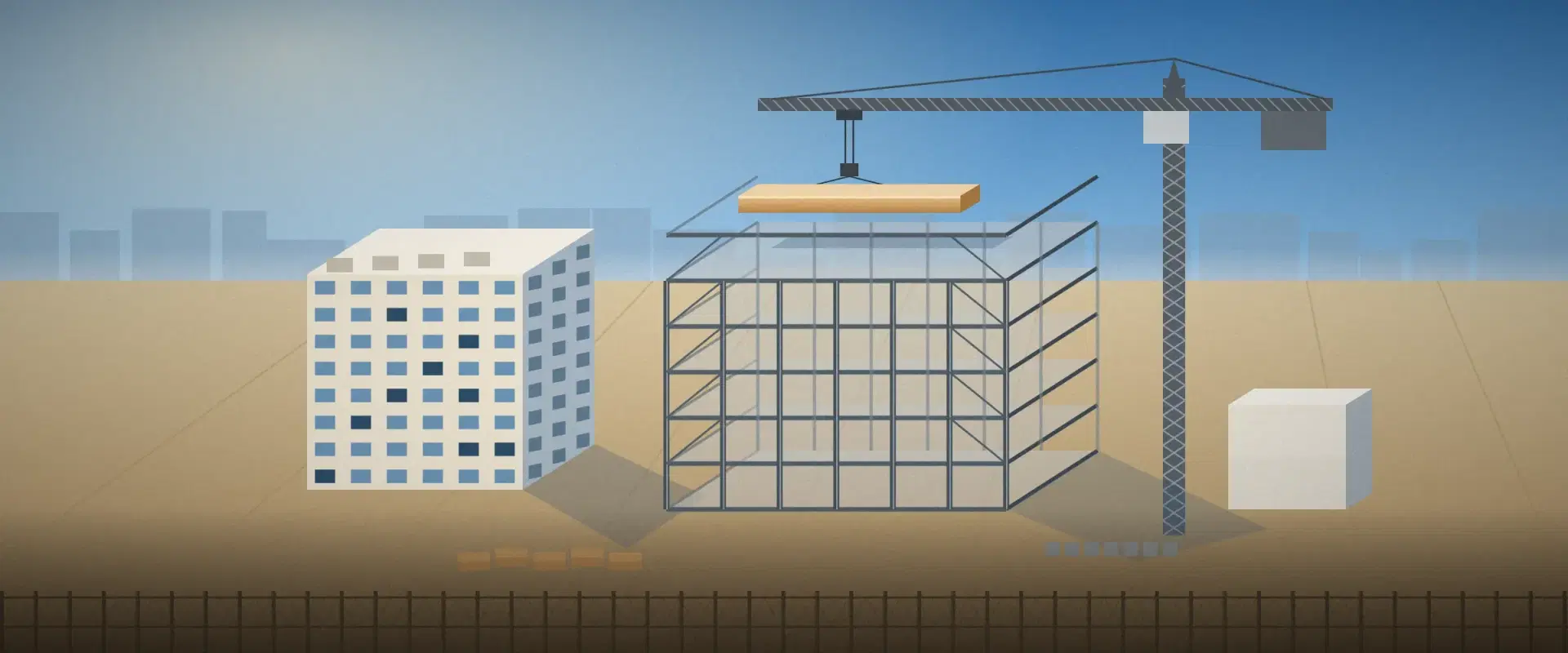
Construction costs have settled at a permanently higher level, JLL said in a global construction cost report released on 15 October 2026. The firm now expects building costs to grow 3% to 6% a year, against a pre-2020 norm of 2% to 3%. The shift matters beyond developers, because it changes how investors read replacement cost in real estate, the price of building an existing property again at today's prices.
For an Indian investor weighing a private U.S. property, the new cost baseline cuts both ways. It slows the arrival of new buildings that would compete for the same tenants, but it also raises what an owner pays for repairs, upgrades and insurance. Replacement cost is therefore a useful check on the price paid for a property, and never a promise that the property will hold its value. The guide to how the main U.S. property types behave sets out the wider market context.
What Replacement Cost in Real Estate Measures
Replacement cost is the estimated expense of building a comparable structure today, using current materials and methods. It covers the building and leaves out the land, according to the property data firm Cotality. Market value is a different figure. It is the price a buyer and a seller agree on in the open market, and it includes the land beneath the building and the location around it.
The two figures can drift far apart, because labour and material costs move replacement cost while local supply and demand move market value. Appraisers in the U.S. use replacement cost in what is called the cost approach, one of three ways to value a property. The other two compare recent sales of similar buildings and capitalise the property's net operating income, the rent left after operating expenses. For a rented building the income method usually leads, so replacement cost works best as a second check rather than the main valuation.
Why U.S. Construction Costs Have Reset Higher
JLL's report puts the rise in global construction costs since 2021 at 25% to 30%. For North America, it forecasts tender prices, the prices contractors bid for new work, to rise a further 3.2% to 4.2% in 2027. That is JLL's forecast rather than a certainty.
The firm links much of the increase to labour. Construction wages rose between 8% and 35% across major markets from 2020 to 2026, and lead times for mechanical, electrical and plumbing systems now exceed 20 weeks. Ruth Hynes, a senior director of research at JLL, described this as "a structural shift rather than a temporary disruption". JLL also said that lower interest rates alone would not offset the extra capital that new projects now need.
How Higher Building Costs Slow New Supply
When building costs rise faster than rents, fewer new projects make financial sense, and the effect is already visible in U.S. apartments. RealPage reported on 6 October 2026 that about 318,000 apartments were completed in the year to the third quarter, roughly 46% below the late-2024 peak of nearly 588,000. Cushman & Wakefield said in July 2026 that about 475,000 units were under construction, or 3.5% of existing stock, the lowest level since 2013.
With fewer new buildings arriving, RealPage said national apartment occupancy averaged 95.4% in the third quarter, and effective asking rents were 0.9% higher than a year earlier. Even so, RealPage data showed the South as the only region where both rents and occupancy were falling.
JLL draws a sector distinction too. It says industrial logistics and data centres have absorbed higher costs because their rents and values outpaced construction inflation over the past five years, while offices and shopping centres face a tighter calculation. For the owner of an existing building, slower new supply can mean fewer rivals for tenants, although it does nothing about competition from older buildings nearby.
The Same Costs Rise for Owners of Existing Buildings
Higher building costs do not stop at new projects. Every roof, lift, boiler or air-conditioning system that an existing property needs is priced at today's rates, and the same supply delays apply. An older building can therefore face a much larger bill when those systems reach the end of their working life.
JLL advises owners to favour retrofitting and repositioning existing buildings where that beats new construction on cost and speed. For investors, this makes the capital plan, the schedule of major repairs and upgrades that a sponsor intends to fund, as important as the purchase price. A sponsor here means the real estate company that finds, buys and manages the property on behalf of its investors.
Insurance is the other link. Property cover is usually based on the cost to rebuild rather than market value, so an estimate that falls behind current costs can leave a building underinsured. Verisk, which studies home insurance data, found that replacement cost estimates drifted by almost 11% after five years without an update. Premiums do not simply follow building costs, though, and broker WTW reported on 19 October 2026 that rates for large commercial property in its portfolio fell 14.5% in the second quarter.
What to Check When a Sponsor Cites Replacement Cost
Sponsors sometimes describe a purchase as below replacement cost, meaning the price paid is less than the cost of building the same property new. The claim is informative only when an investor can see how it was worked out, so these questions are worth putting to the sponsor.
- Where the replacement cost estimate came from, when it was prepared, and whether an independent cost consultant or the sponsor itself produced it.
- How the purchase price splits between land and building, since only the building can be replaced.
- The age of the main building systems, the capital plan for the next few years and the contingency set aside for cost overruns.
- The insured value of the building and when it was last updated.
- How many competing buildings are planned or under construction nearby.
- Whether the business plan depends on rents rising to cover higher operating and repair costs.
A low price compared with replacement cost can also be a warning. Buildings sometimes trade below their rebuilding cost because the location is weakening, the design is outdated or rents are falling. Verisk found that the average U.S. home in 2023 had a market value about 13% below its replacement cost estimate, which shows that such a gap is common and not, on its own, a sign of value.
Risks and Limits of Relying on Replacement Cost
Replacement cost is an estimate, and estimates differ between consultants, change with prices and are rarely audited. A building can sell for less than its replacement cost for years, and the gap may never close. Investors in private U.S. real estate can lose capital, may be unable to exit before the property is sold, and may see distributions reduced or not paid if tenants leave or costs rise faster than rent.
Debt adds another layer of risk. A property that must refinance at higher interest rates may have less cash for repairs, and a property with a large loan can lose value faster than one without. Holding a single building or a single city also concentrates exposure to local supply.
Currency is a separate risk again. Money sent from India under the Liberalised Remittance Scheme is invested in dollars, so the rupee value of the investment moves with the exchange rate. The guide to why Indian investors hold dollar assets covers that question separately.
A Check on the Price Paid, Not a Floor Under Value
JLL's report confirms that building in the U.S. now costs more than it did before 2020, and the firm expects that to continue. For an existing property, this limits how quickly new competitors appear, and it raises the cost of keeping the building in good repair and properly insured.
Read together, the evidence makes replacement cost most useful as a test of the price paid. It shows how a purchase compares with the cost of building new, but it says nothing on its own about whether tenants will stay or whether rent will cover rising costs. Those answers sit in the property's income, debt and capital plan, which the guide to U.S. property types and market conditions explores in more depth.
Indian investors weighing these questions can also review the steps involved in investing from India before any money leaves the country. Eligible investors can review how investing in U.S. real estate from India works on Raveum, including the property, sponsor, ownership structure, fees, risks and offering documents for each opportunity.
Frequently Asked Questions
What is replacement cost in real estate?
Replacement cost is the estimated cost of building a comparable structure today, using current materials, labour and methods. It covers the building only and excludes the land. Investors use it to compare the price paid for a property with the cost of building something similar new, which shows how easily a competing building could appear nearby.
Does replacement cost include the value of land?
No. Replacement cost covers only the structure, because land cannot be rebuilt. Market value includes the land and the location, which is why the two figures can differ sharply. In expensive cities the land can be a large share of the price, so it helps to ask a sponsor how the purchase price splits between land and building.
Is buying below replacement cost a good sign?
It can be a useful sign, but it is not proof of a sound investment. A property may trade below its rebuilding cost because its location is weakening, its design is outdated or its rents are falling. Check where the estimate came from, the building's repair needs and local demand before giving it much weight.
How do rising construction costs affect existing buildings?
Higher construction costs make new projects harder to justify, which can slow the supply of competing buildings. They also raise the cost of repairs, system replacements and insurance for existing owners. The overall effect depends on the building's age, its capital plan and whether rents in its market can absorb the higher costs.
How is replacement cost different from market value?
Market value is the price a buyer and a seller agree on, and it includes the land and the location. Replacement cost is the cost of rebuilding the structure at today's prices. Labour and material costs move replacement cost, while local supply and demand move market value, so a property can be worth more or less than its rebuilding cost.
What are the risks of relying on replacement cost when investing?
Replacement cost estimates vary between consultants and are rarely audited, and a building can sell below its rebuilding cost for years. Private U.S. real estate also carries the risk of losing capital, being unable to sell, distributions not being paid, refinancing at higher rates and currency movements. Treat replacement cost as one check among several.
This article is for general education only and is not investment, tax or legal advice. Rules change and depend on individual circumstances. Investing in private real estate involves risk, including loss of capital, illiquidity, falling property values, distributions not being paid and currency movements. Participation is limited to non-U.S. persons under SEC Regulation S and verified U.S. accredited investors under Regulation D Rule 506(c), and offerings on Raveum are not open to the general public.