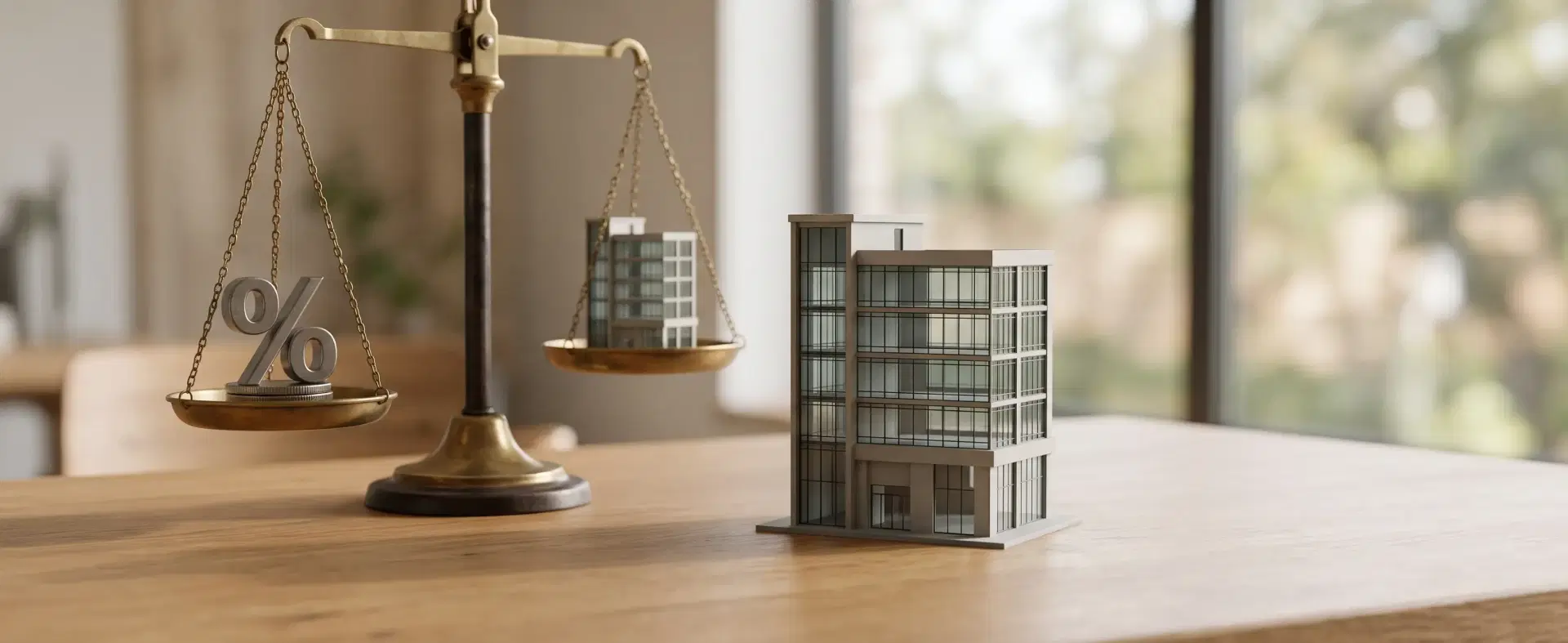
The Federal Reserve held the federal funds target range at 3.75% to 4% on 28 October 2026, and two of the twelve voting members wanted an increase. That split matters to anyone with a stake in a private U.S. building, because interest rates sit at the centre of commercial property valuation, the process that turns a building's rent, its comparable sales and its replacement cost into one estimate of what it is worth.
That estimate is useful, but it is not a price. JLL chief executive Christian Ulbrich said on the company's third-quarter earnings call that deals were taking longer to close and that price negotiations had become more intense, Bisnow reported this week. When buyers and sellers disagree about price, the value printed on an investor's statement can sit some distance from what a buyer would pay. The guide to how U.S. property types and markets behave covers the assets these valuations apply to.
What a Valuation Actually Measures
A valuation is an opinion of what a property would sell for, stated as of a particular date. In the U.S., it is usually prepared by a licensed appraiser, either for a lender deciding how much to lend or for a sponsor reporting the value of a deal to its investors. A sponsor is the firm that finds, buys and manages the property on investors' behalf.
The opinion rests on evidence, but it remains an opinion. Two qualified appraisers can study the same building and reach different figures, because each makes judgements about future rent, costs and what buyers will accept. That is why the date and the method matter as much as the number itself.
The Three Approaches Behind Every Appraisal
The appraisal and evaluation guidelines for U.S. lenders recognise three approaches to value, namely cost, income and sales comparison. Appraisers usually work through more than one and then reconcile the results, giving most weight to the approach the evidence supports best.
The Income Approach
For a building that earns rent, the income approach usually carries the most weight. It starts with net operating income, the rent a property collects after operating costs such as property tax, insurance and maintenance, but before loan payments.
The appraiser then converts that income into a value in one of two ways. Direct capitalisation divides one year of stabilised income by a capitalisation rate, or cap rate, which is the ratio of income to price that buyers currently accept for similar buildings. A discounted cash flow model instead projects income over a holding period, adds an estimated sale value at the end and discounts every amount back to today at a rate that reflects risk.
The Sales Comparison Approach
This approach looks at recent sales of similar buildings nearby and adjusts for differences in size, age, location and lease terms. It works well when many similar properties trade. It is weaker when few buildings change hands, because the appraiser has fewer recent prices to work from and older sales may no longer reflect the market.
The Cost Approach
The cost approach asks what it would take to buy the land and build an equivalent property today, less an allowance for wear and age. It is most useful for newer or specialised buildings, and it sets a rough ceiling on value, since few buyers pay more for an existing building than the cost of building a new one.
How Commercial Property Valuation Responds to Interest Rates
Interest rates reach a valuation through two channels. The first is the cost of debt. Most commercial buildings are bought partly with a loan, so a higher interest rate leaves less of the rent for the owner after loan payments, and buyers bid less for the same income as a result.
The second channel is the alternative on offer. When safer assets such as U.S. government bonds pay more, buyers ask for more income from each dollar they put into property. In the income approach, that shows up as a higher cap rate or discount rate, and the same net operating income then produces a lower value. Falling rates work the other way, although they do not lift a value if the rent itself weakens.
Recent market activity shows both forces at work. Avison Young counted US$143 billion of U.S. investment sales in the third quarter of 2026, the largest third quarter since 2022, according to its quarterly report as covered by GlobeSt. In the same month, CBRE chief executive Bob Sulentic said higher rates were leading some buyers and sellers to rework or delay agreed deals, CoStar News reported. Transactions are still closing, but each one now involves a harder conversation about price.
Why the Value on a Statement Can Lag the Market
Private property is appraised only from time to time, often once a quarter or once a year, and each appraisal leans on sales that have already closed. As a result, appraised values tend to move later and more gently than prices in markets that trade every day. Joseph Gyourko of the Wharton School found that private real estate values lag listed property prices, and traced the pattern to the infrequent nature of the appraisal process.
Brad Case of Nareit made a related point in 2017, writing that appraisal-based values should closely resemble the listed market while lagging significantly behind it. In practice, when rates rise quickly, a statement may show a value that buyers would no longer pay. When conditions improve, the statement may be slow to show that too.
What the Valuation Means Inside the Structure Indian Investors Hold
Indian investors and other offshore investors typically hold U.S. property through a U.S. corporation, known as a blocker, which owns the property interest. The investor owns shares in that corporation rather than the building, and typically receives Form 1042-S for U.S. tax withheld on distributions. The guide to how this structure is taxed in the U.S. and India sets out the detail.
That structure shapes how a valuation reaches the investor. The value of the investor's shares depends on the property's appraised value, minus the loan taken out against it and any costs inside the entity. Debt magnifies movements, so a modest change in the building's value can mean a larger change in the value of the equity. The rupee adds a further layer, because a value reported in dollars converts into more or fewer rupees as the exchange rate moves, as the guide to dollar assets and currency diversification explains.
Risks and Limits of a Property Valuation
An appraisal is an estimate, and it can be wrong in either direction. It does not mean a buyer exists at that figure, and private real estate interests are illiquid, so an investor usually cannot sell at the reported value before the property itself is sold. The explainer on liquidity in real estate investment covers what that means in practice.
Other limits deserve plain mention. The sponsor usually chooses the appraiser and the timing, and where fees are linked to reported value, the incentives deserve a question. Valuations also rest on assumptions about tenants staying, rents holding and loans being refinanced, and any of these can fail. Investors can lose capital, distributions may not be paid, property values can fall, leverage can deepen losses and currency movements can reduce the rupee value of any amount received.
Questions Worth Asking About a Reported Value
A few direct questions turn the valuation from a number into something an investor can judge. Most can be answered from the offering documents or by asking the sponsor.
- Who prepares the valuation, and is the appraiser independent of the sponsor?
- Which approach carries the most weight, and what cap rate or discount rate sits behind it?
- How often is the property revalued, and what is the date of the latest appraisal?
- How much debt sits on the property, and when does the loan mature?
- Are any fees calculated on the reported value?
Clear answers say more about a deal than the valuation figure alone, because they show how much judgement sits inside it. They also make it easier to compare one opportunity with another on equal terms.
A Valuation Is an Estimate With a Date Attached
The Fed's split vote this week is a reminder that the inputs to a valuation can change faster than the valuation itself. Rent, comparable sales and building costs all feed the estimate, but the rate at which buyers convert income into price moves with the cost of money, and an appraisal catches up only when it is next updated.
For an Indian investor, the sensible way to read a reported value is as an informed estimate on a stated date, built with stated methods, sitting on top of a structure with its own debt and currency exposure. Read that way, it supports a measured decision rather than a reaction to every rate headline. The guide to U.S. property types and market conditions places these valuations in the wider market. Eligible investors can review how investing in U.S. real estate from India works on Raveum, including the property, sponsor, ownership structure, fees, risks and offering documents for each opportunity.
Frequently Asked Questions
How is commercial property valued in the U.S.?
Commercial property in the U.S. is usually valued by a licensed appraiser using three approaches, namely income, sales comparison and cost. For a building that earns rent, the income approach usually carries the most weight. The appraiser reconciles the approaches into one opinion of value, stated as of a specific date.
Which valuation method is used most for rental commercial buildings?
The income approach is used most for rental commercial buildings, because buyers price them on the income they produce. The appraiser estimates net operating income and converts it into value, either by dividing one year of income by a capitalisation rate or by discounting several years of projected income and an estimated sale value.
Why do interest rates affect commercial property values?
Higher interest rates raise the cost of the loan most buyers use and make safer assets such as government bonds more attractive. Buyers then ask for more income from each dollar invested, which lowers the value of the same income. Lower rates work the other way, although weaker rent can outweigh them.
How often is a private real estate investment revalued?
It depends on the sponsor and the offering documents. Many private real estate investments are revalued once a quarter or once a year, through an outside appraisal or an internal estimate. Check the valuation policy, the date of the latest valuation and who prepared it before relying on any reported figure.
Can I sell my stake at its appraised value?
Not necessarily. An appraised value is an estimate, not an offer from a buyer. Private real estate investments are illiquid, transfers are often restricted, and you may have to wait until the property is sold. Any earlier sale, where the documents allow one, may happen at a price below the reported value.
Why can the value on my statement differ from market prices?
Private property is appraised only from time to time and relies on sales that have already closed, so reported values tend to change later and more gently than prices in markets that trade daily. When rates move quickly, a statement can show a figure that buyers would no longer pay.
This article is for general education only and is not investment, tax or legal advice. Rules change and depend on individual circumstances. Investing in private real estate involves risk, including loss of capital, illiquidity, falling property values, distributions not being paid and currency movements. Participation is limited to non-U.S. persons under SEC Regulation S and verified U.S. accredited investors under Regulation D Rule 506(c), and offerings on Raveum are not open to the general public.
