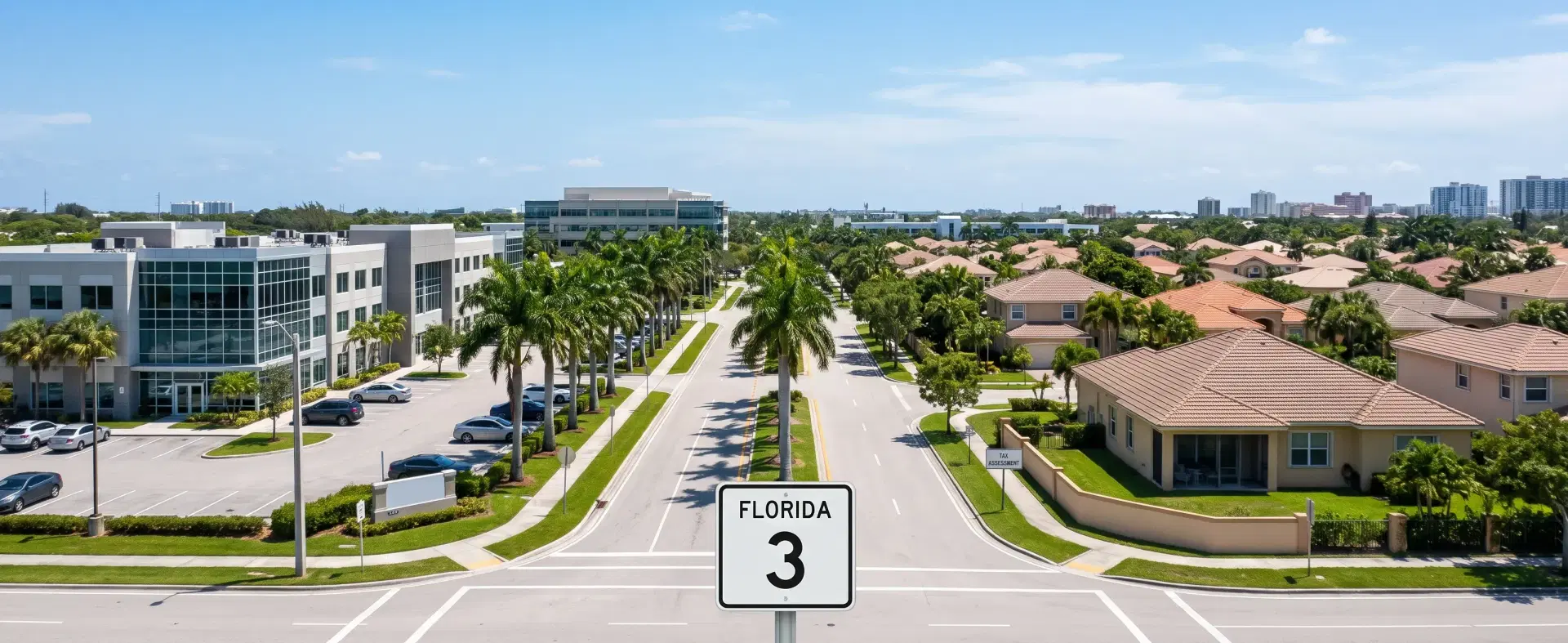
Florida voters approved Amendment 3 on 3 November 2026, with about 62% voting yes against the 60% needed to pass, according to unofficial results reported by News4JAX. The measure raises the exemption that lowers tax bills on primary homes and slows how fast assessments on other property can rise. For an Indian investor weighing U.S. income-producing property, the vote is a reminder that commercial property tax is set locally, can change at the ballot box and must be paid before anything reaches a property's owners.
The central point is easy to state. When a state gives homeowners relief, the cost of local services does not disappear, and part of it can move onto the offices, warehouses, shopping centres and apartment buildings that do not qualify for that relief. Florida's measure also limits assessment growth on those buildings, so its effect cuts both ways. Knowing how the tax is set, who pays it under the lease and when it resets is therefore part of judging any U.S. property, alongside how U.S. commercial property types work.
How Commercial Property Tax Is Calculated in the U.S.
Property tax in the U.S. is a local tax on the value of land and buildings. Counties, cities, school districts and special districts levy it, not the federal government, and it is separate from the income tax due on rent and sale profits. That income tax, and how the blocker corporation holding an Indian investor's interest is taxed, is covered in the U.S. real estate tax guide for Indian investors.
The arithmetic follows a similar pattern in most states. Florida's Department of Revenue sets it out in three steps on its property tax page for taxpayers. Assessed value is market value minus any assessment limits, taxable value is assessed value minus exemptions, and the tax is taxable value multiplied by the millage rate each local taxing authority sets after public hearings.
Commercial buildings are usually valued on the income they produce. The Cook County Assessor's Office in Illinois, for example, says it uses the income approach to reassess most commercial properties. It starts from market rent, subtracts vacancy and operating costs to reach net operating income and converts that income into a value. In practice, a building that earns more rent can face a higher assessment, which ties the tax bill to the property's own performance.
What Amendment 3 Changes for Homes and Commercial Property
Amendment 3 lifts Florida's non-school homestead exemption to US$150,000 for 2027 and US$250,000 for 2028, after which it adjusts with inflation, according to the Florida Chamber of Commerce's summary of the measure. School taxes are excluded. The exemption applies only to a primary residence, so offices, warehouses, shopping centres, rental homes and apartment buildings do not receive it.
Those properties gain something different. From 1 January 2027, the yearly cap on assessment increases for non-homestead property falls from 10% to 5% for non-school levies. A lower cap slows how quickly an existing owner's assessed value can catch up with market value, although it does not limit the tax rate that is applied to that value.
The harder question is who replaces the lost revenue. Florida's Revenue Estimating Conference estimated in its July 2026 impact statement that the measure would reduce local non-school revenue by about US$4.9 billion in the 2027-28 fiscal year and US$8.7 billion in 2028-29, rising to about US$11.8 billion a year when fully in place. These are official estimates, not outcomes. The Tax Foundation argued in an October 2026 analysis of Amendment 3 that a greater share of the burden would fall on owners of non-homestead property, and that renters could feel it through higher rent. Local governments may instead cut spending, and Jacksonville officials told News4JAX the city would make adjustments.
Who Pays Commercial Property Tax Depends on the Lease
Whether a higher tax bill reaches investors depends mostly on the lease. In a triple net lease, the tenant pays some or all of the property taxes, insurance and maintenance in addition to rent, as Nolo's guide to commercial leases explains. A single-tenant net lease building can therefore pass much of a tax rise to its tenant, although the tenant's ability to keep paying still matters.
Other property types work differently. Apartment owners generally pay property tax themselves and recover higher costs only if local demand lets them raise rents when leases renew. Many office and multi-tenant leases sit in between, with the owner paying the tax in a base year and the tenant paying all or part of later increases. The lease terms, not the property type label, show where the cost actually falls.
Reassessment at Sale and the Property Budget
The most common surprise comes at purchase. Florida's Department of Revenue states that when someone acquires property, its assessed value is set equal to market value. Assessment caps protect owners who have held a building for years, but that protection ends when the building changes hands. A property bought well above its old assessed value can therefore see its tax bill rise at the next assessment.
For an investor, the check is whether the sponsor's budget uses the tax the buyer will pay after reassessment, not the tax the seller paid. A budget that carries the seller's figure forward can overstate the income available for distributions, which is one reason to read a real estate pro forma closely. Owners can also contest an assessment. In Florida, petitions go to the county Value Adjustment Board, which hears appeals on assessments, exemptions and changes of ownership, and other states run their own processes.
Risks and Limits of Commercial Property Tax for Investors
Property tax is a cost that investors cannot control and that can move against them. A local government facing a revenue gap can raise millage rates on all remaining taxable property, and the Florida Chamber noted that any increase would apply to businesses and rental properties as well as homes. Higher tax bills can reduce net operating income, lower what a buyer will pay and leave less cash for distributions, which may be reduced or not paid.
Lease protection has limits too. A tenant that pays the tax under a net lease may struggle if costs rise sharply, and a vacant building passes nothing on. Several parts of Amendment 3 also depend on future legislation, so the rules may change again. These risks sit alongside the usual ones in private real estate, including loss of capital, illiquidity, falling property values, tenants leaving, leverage and refinancing, concentration and currency movements between the dollar and the rupee.
A Local Vote Inside Every Property Budget
Florida's vote shows how a decision by voters in one state can reach the operating budget of a building held through an offshore structure. The amendment lowers homeowner bills, slows assessment growth on commercial and rental property, and leaves local governments to decide how to close a gap that official estimates put in the billions of dollars. None of that settles whether a particular property becomes more or less expensive to own.
What it does settle is where to look. An investor studying a U.S. property can ask how its commercial property tax was set, whether the budget reflects reassessment at purchase, who pays increases under each lease and what revenue pressure the local government faces. The U.S. real estate market guide connects these questions to each property type. Eligible investors can review how investing in U.S. real estate from India works on Raveum, including the property, sponsor, ownership structure, fees, risks and offering documents for each opportunity.
Frequently Asked Questions
How is commercial property tax calculated in the U.S.?
Commercial property tax is usually the property's taxable value multiplied by the local millage rate. Assessors often value commercial buildings on the income they produce, then apply any assessment limits and exemptions. Each county, city and school district sets its own rate, so two similar buildings in different places can carry very different tax bills.
Who pays property tax on a commercial lease, the tenant or the landlord?
It depends on the lease. Under a triple net lease, the tenant pays some or all of the property taxes along with insurance and maintenance. Under other leases, the owner pays the tax and the tenant may cover only increases above a base year. Investors should read the actual lease terms rather than assume either way.
Does commercial property get reassessed when it is sold?
In many states, yes. Florida's Department of Revenue says that when property is acquired, its assessed value is set at market value, which ends any protection an assessment cap gave the previous owner. A buyer paying well above the old assessed value can therefore face a higher tax bill from the next assessment onwards.
Can you appeal a commercial property tax assessment?
Yes. Owners can usually challenge an assessment they believe is too high. In Florida, owners or their representatives file a petition with the county Value Adjustment Board, generally within 25 days of the notice of proposed property taxes. Other states run their own boards, with their own deadlines and rules on the evidence required.
Do foreign investors pay property tax on U.S. property?
Yes. Property tax is charged on the property itself, so a building held for Indian investors pays the same local tax as one held by U.S. owners. In a private deal, the tax is normally paid from the property's income before any distributions, and it is separate from both U.S. and Indian income tax.
Can a rise in property tax reduce distributions to investors?
Yes. Property tax is an operating cost paid before distributions, so a higher bill that tenants do not cover reduces the cash left for investors. Distributions in private real estate are never certain and can be reduced or stopped, and lower net operating income can also reduce what a buyer will pay at sale.
This article is for general education only and is not investment, tax or legal advice. Rules change and depend on individual circumstances. Investing in private real estate involves risk, including loss of capital, illiquidity, falling property values, distributions not being paid and currency movements. Participation is limited to non-U.S. persons under SEC Regulation S and verified U.S. accredited investors under Regulation D Rule 506(c), and offerings on Raveum are not open to the general public.