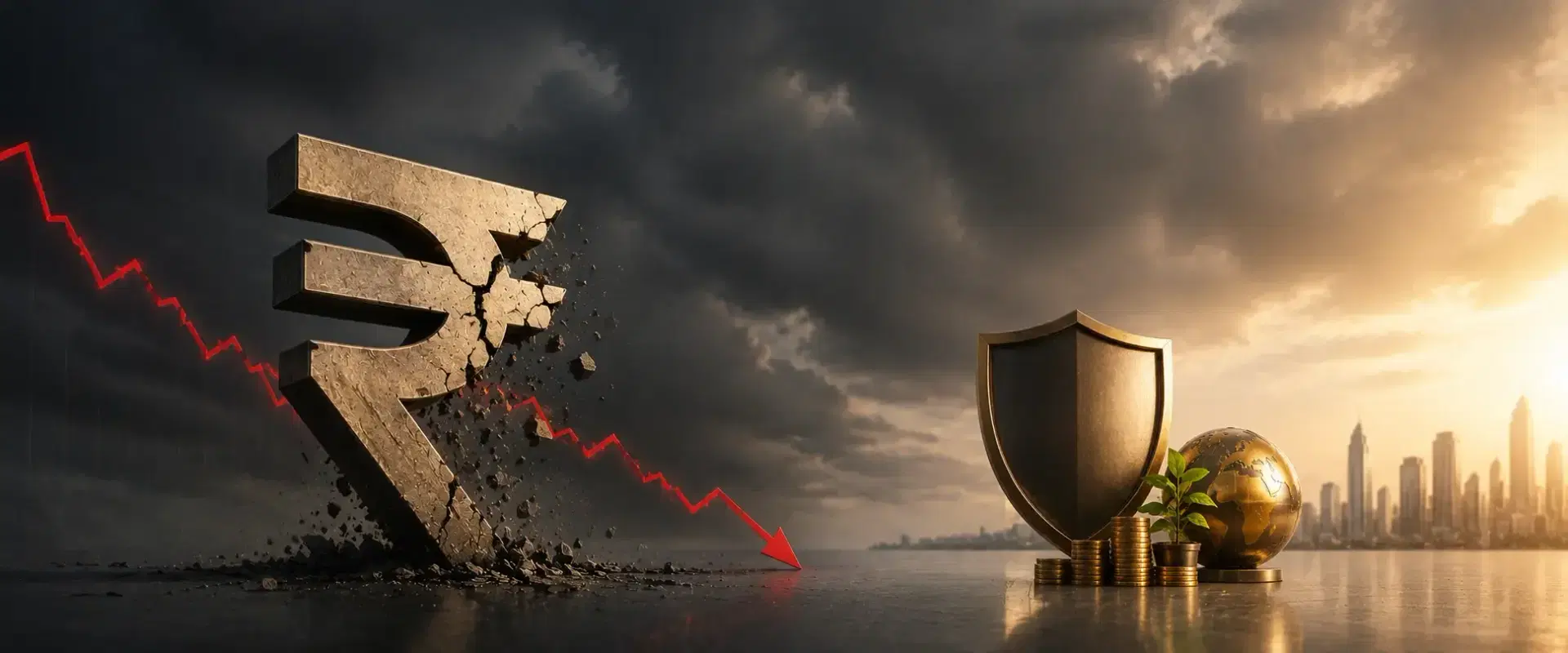
Have you watched the news recently and felt worried? The Indian Rupee is making headlines for all the wrong reasons, and investors are starting to ask how they can hedge against rupee depreciation before it affects long-term wealth.
On May 20, 2026, the rupee hit an all-time low of ₹96.89 against the US dollar. In just the first few months of this year, our currency has lost about 8% of its value. For the first time in history, people are watching the rupee drift dangerously close to the ₹97 mark.
To a layman, this might look like a simple math equation. But it is much more serious. The exchange rate affects your daily life. It changes the price of petrol for your scooter. It increases the cost of cooking oil in your kitchen. It even makes buying a new smartphone more expensive.
In this blog, we will explain exactly what is happening to the Indian economy. We will break down why the rupee is falling. We will look at how the Reserve Bank of India (RBI) is fighting back. Most importantly, we will explain how to protect wealth from rupee fall using the same strategies that the top 1% of wealthy Indians are already exploring. By the end, you will understand how you can follow their example.
Why is the Indian Rupee Falling?
Think of currency like tomatoes in a vegetable market. If everyone wants tomatoes and there are very few left, the price goes up. Right now, the whole world wants US dollars. Because the demand for dollars is so high, the "price" of the dollar goes up. This automatically makes the Indian rupee look weaker in comparison.
But why is the demand for dollars so high right now? There are four main reasons:
1. The High Price of Crude Oil
India does not produce enough oil. We import nearly 85% of our crude oil from other countries. When we buy this oil, we have to pay the sellers in US dollars. Recently, global oil prices have shot up. Brent crude oil crossed $111 per barrel because of a reported attack on a nuclear facility in the UAE. Because oil is so expensive, India needs a massive amount of dollars to pay its bills. This huge demand makes the dollar stronger and crushes the rupee.
2. Foreign Investors are Leaving
Foreign investors bring billions of dollars into the Indian stock market. But right now, they are selling their shares and leaving. Over the past 18 months, Foreign Institutional Investors (FIIs) have pulled a staggering $47 billion (about ₹2.62 lakh crore) out of India. When they sell Indian shares, they take rupees, convert them into dollars, and take the money back home. This mass exit drains dollars from our country and weakens the rupee.
3. The Trade Deficit Trap
Imagine your monthly salary is ₹50,000, but you spend ₹70,000. You are in a deficit. Countries have this problem too. When India buys (imports) more goods from foreign countries than it sells (exports) to them, it creates a "trade deficit." By November 2024, India's trade deficit hit a record high of $37.84 billion. We are spending too many dollars on foreign goods, leaving fewer dollars inside India.
4. America is Paying High Interest
The central bank of America (the Federal Reserve) has kept its interest rates very high. Currently, US Treasury yields are around 4.60%. If you are a global investor, you want your money in a safe place that pays high interest. Right now, America is the safest and best-paying place. So, money is flowing out of developing countries like India and going straight to the United States.
What is the RBI Doing to Fix This?
The Reserve Bank of India (RBI) is our central bank. It is the ultimate guardian of our money. The RBI acts like a strict monitor to stop the rupee from falling too fast. Here is how they are fighting the crisis:
Selling Dollars Everyday
The RBI has a massive savings account called "foreign exchange reserves." To stop the rupee's free fall, the RBI directly sells US dollars from its savings into the open market. Recently, they have been selling about $1 billion every single day. This increases the supply of dollars in the market, which helps to cool down the exchange rate.
Special Help for Oil Companies
Oil Marketing Companies (OMCs) are the biggest buyers of dollars in India. If they buy dollars from the open market, it causes a huge shortage and crashes the rupee. To stop this panic, the RBI created a "Special Dollar Window." This allows oil companies to buy dollars directly from the RBI instead of the open market.
Complex Swap Auctions
The RBI recently announced a USD 5 billion buy-sell swap auction. This is a smart trick. The RBI buys dollars from banks today and promises to sell them back later. This pumps rupee cash into the banking system without permanently losing their precious dollar savings.
Changing the Interest Rates
When things get very bad, the RBI can increase the domestic interest rate (Repo Rate). Higher interest rates make Indian bonds more attractive to foreign investors. If foreign investors come back to earn high interest, they bring dollars with them. This helps support the rupee.
What the Rich Are Doing (Moving Money to the US and Hedging)
While the average Indian keeps 100% of their savings in rupees out of habit, smart money is doing the exact opposite. The top 1% of wealthy Indians are actively changing their strategy to survive this crisis.
Buying US Real Estate
Rich Indians are legally moving their money out of the country to buy dollar-denominated assets. They love United States real estate. Why? In India, if you rent out a house, you earn a tiny yield of 2% to 3%. In the US, real estate provides a stable income of 6% to 8%. Furthermore, the US has 200 years of strong property laws and total transparency. More importantly, the rent can create passive income in dollars.
Using the LRS System
Under LRS for real estate investment, Indian citizens can send up to $250,000 abroad every year. Last financial year (FY24), wealthy Indians used this scheme to move over $31 billion out of India. For the rich, this is no longer about buying a holiday home. It is an explicit strategy to diversify their currency and protect their wealth from a falling rupee.
Corporate Hedging Strategies
Large companies are also fighting back. Exporters and importers use a financial tool called "hedging". A hedge against rupee depreciation works like an insurance policy for currency. If a company knows they will need to pay dollars in three months, they lock in today's price using forward contracts. Because the market is so volatile right now, companies prefer shorter-term hedges just to survive the immediate future.
Why You Should Follow Their Example
You might think that investing in dollars is only for billionaires. But the math applies to every single Indian.
The rupee is structurally broken. It has been getting weaker for two decades. Historically, the rupee loses about 3% to 5% of its value against the dollar every single year. This acts like a hidden tax on your wealth, making it essential for you to have dollar income investments as a shield.
Imagine you invest in the Indian stock market (Nifty or Sensex). You might earn a good return. But if you adjust that return against the falling rupee, your real global wealth has barely grown.
If you want to send your kids abroad for education, you will pay in dollars. If you want to travel the world, you will pay in dollars. Even the electronics and cooking oil you buy in India are priced based on dollars. Earning a yield of 6-8% in US real estate beats earning a small yield in a depreciating rupee. Moving a part of your portfolio to dollar assets is not anti-India. It is basic portfolio hygiene. You must protect your purchasing power.
How Platforms Like Raveum Are Making That Switch Possible
In the past, understanding how to send money abroad from India for investment or using complex financial tools was nearly impossible for ordinary people. Buying US real estate to hedge against currency depreciation required millions of dollars, restricting this strategy to the ultra-rich. Today, fractional investments have completely changed the game.
Fractional ownership allows everyday investors to buy small "shares" or fractions of premium international properties for a fraction of the total cost.
By using modern investment platforms like Raveum, investors can pool capital into high-quality, dollar-earning real estate as a structured way to hedge against rupee depreciation. This democratizes access to global markets, allowing you to earn rental income in dollars and benefit from property appreciation without needing massive upfront capital.
These platforms are democratizing finance. They give Indian individuals the exact tools they need to navigate the currency storm safely.
Conclusion: What Does the Future Hold?
The biggest question on Dalal Street right now is whether the rupee will ever recover.
Sadly, the experts are not very optimistic. Financial analysts at DBS Bank recently lifted their forecast. They believe the US Dollar to Rupee exchange rate will stay stuck between ₹95 and ₹100 for the rest of 2026. Other platforms, like BookMyForex, also predict that the average rate will stay firmly around ₹96 well into 2027.
The Indian economy is facing a harsh reality. As long as global crude oil prices stay above $100, the Middle East remains tense, and the US keeps its interest rates high, the rupee will suffer. The days of a ₹70 or ₹80 dollar are gone.
As an everyday Indian, you do not need to panic. But you must be smart. Take a lesson from India's top 1%. Stop keeping 100% of your financial life tied to a depreciating currency. Start exploring compliant ways to diversify and invest in dollar assets from India. Look into dollar-denominated assets. Use trusted financial platforms like Raveum to hedge against rupee depreciation. By understanding the simple economics of the falling rupee, you can protect your family's future and build wealth that survives any crisis.